Mr. Sharma, 68, owns a fully paid home worth ₹80 lakhs in Pune.
His pension is ₹12,000 per month. His monthly expenses – medicines, groceries, utilities, and the occasional doctor visit – come to ₹22,000.
Every month, he is short by ₹10,000. His children are working in different cities, doing their best to send money. But the dependence weighs on everyone.
Meanwhile, ₹80 lakhs of wealth sits in the walls around him – completely idle.
This is India’s hidden retirement crisis. Millions of senior citizens are asset-rich and cash-poor – owning valuable properties while struggling to meet monthly expenses. They have spent their lives building equity in their homes, and yet that equity provides zero monthly income.
The reverse mortgage was designed specifically for this situation. It transforms your home from a static asset into a monthly income-generating instrument – without requiring you to sell it, vacate it, or hand it over to anyone during your lifetime.
Here is everything you need to know – with our free Reverse Mortgage Calculator to see exactly what monthly income your home can generate.
👉 Calculate your monthly reverse mortgage income with our free Reverse Mortgage Calculator →
What Is a Reverse Mortgage and How Does It Work?
A reverse mortgage is the opposite of a regular home loan. In a regular loan: you borrow money and repay it monthly over time. In a reverse mortgage: the bank pays you monthly income against the security of your home – and there is no repayment required during your lifetime.

The Core Reverse Mortgage Structure:

Regular Home Loan: You pay the bank every month
Reverse Mortgage: The bank pays YOU every month

Your home is the collateral - but you continue living in it
No monthly repayment obligation during your lifetime
Loan is settled only after: you pass away, sell the home, or permanently move out

Monthly Income Formula:
Monthly Payment = (Property Value × LTV Ratio) ÷ (Loan Tenor in Months)

Where:
LTV Ratio: Typically 50-60% of appraised property value
Tenor: Maximum 15-20 years (or lifetime annuity option)
When the loan ends – either through the borrower’s passing or permanent relocation – the heirs have two choices. They can repay the outstanding loan amount (principal + accumulated interest) and retain the property, or allow the bank to sell the property and settle the outstanding loan – with any surplus returned to the heirs.
The critical protection: The borrower can never owe more than the property is worth. Even if the accumulated loan exceeds the property value at settlement – the heirs have no personal liability beyond the property itself.
Reverse Mortgage Calculator: Understanding Your Monthly Income
The monthly income you receive from a reverse mortgage depends on four key inputs:
| Input | What It Means | Typical Range |
|---|---|---|
| Property Market Value | Current appraised fair market value | ₹25L – ₹5 crore |
| LTV Ratio | % of property value the bank lends against | 50-60% (NHB guideline) |
| Borrower Age | Older borrowers get higher monthly payments | Minimum 60 years |
| Loan Tenor | Duration over which payments are spread | 10-20 years (or lifetime) |
Reverse Mortgage Income Calculation:

Example: Mr. and Mrs. Sharma, Age 68 and 65
Property Value: ₹80,00,000
LTV (50%): ₹40,00,000 (Maximum Loan)
Tenor: 15 years (180 months)
Monthly Payment (simple): ₹40,00,000 ÷ 180 = ₹22,222/month

Note: Actual payment is slightly lower after accounting for
interest accumulation on outstanding loan balance.
Realistic estimate at current rates: ₹18,000-₹20,000/month
👉 Get your precise monthly income estimate with our free Reverse Mortgage Calculator →
Monthly Income Estimates by Property Value
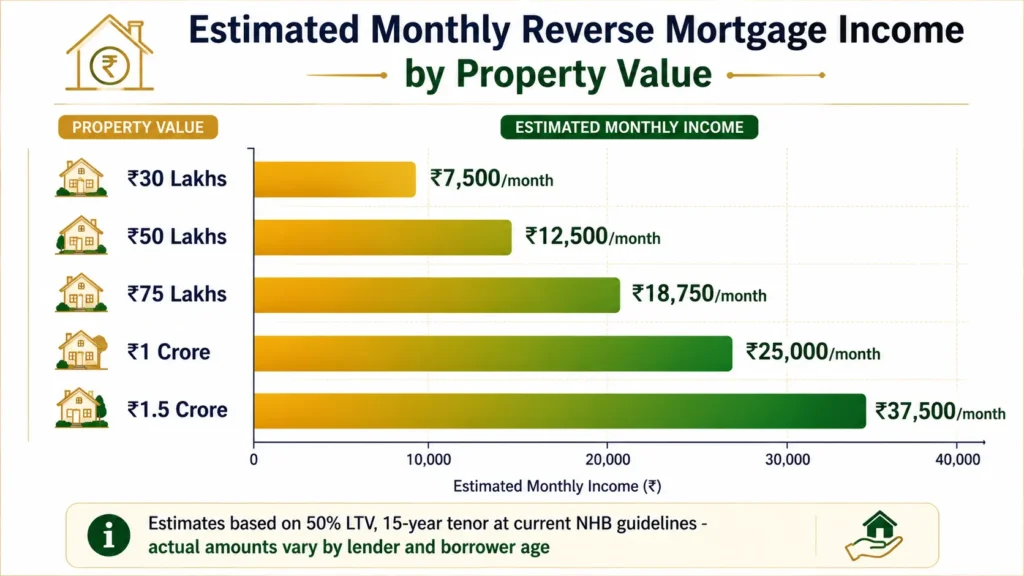
| Property Value | LTV (50%) | Loan Amount | Monthly Income (15yr) | Monthly Income (20yr) |
|---|---|---|---|---|
| ₹25,00,000 | ₹12,50,000 | ₹12,50,000 | ₹5,800-₹6,500 | ₹4,500-₹5,200 |
| ₹40,00,000 | ₹20,00,000 | ₹20,00,000 | ₹9,200-₹10,400 | ₹7,200-₹8,300 |
| ₹50,00,000 | ₹25,00,000 | ₹25,00,000 | ₹11,500-₹13,000 | ₹9,000-₹10,400 |
| ₹75,00,000 | ₹37,50,000 | ₹37,50,000 | ₹17,300-₹19,500 | ₹13,500-₹15,600 |
| ₹1,00,00,000 | ₹50,00,000 | ₹50,00,000 | ₹23,000-₹26,000 | ₹18,000-₹20,800 |
| ₹1,50,00,000 | ₹75,00,000 | ₹75,00,000 | ₹34,600-₹39,000 | ₹27,000-₹31,200 |
| ₹2,00,00,000 | ₹1,00,00,000 | ₹1,00,00,000 | ₹46,100-₹52,000 | ₹36,000-₹41,600 |
Note: Estimates based on 50% LTV with current interest rate of 9.5-10.5%. Actual payments vary by lender, borrower age, and current interest rate at origination.
The age advantage: Older borrowers receive higher monthly payments because the expected tenure of loan is shorter. A 70-year-old receives more per month than a 62-year-old on the same property – because the bank calculates payments based on life expectancy tables.
NHB Guidelines: The Regulatory Framework for India
India’s reverse mortgage scheme operates under guidelines set by the National Housing Bank (NHB) – the regulator for housing finance in India:
| Parameter | NHB Guideline |
|---|---|
| Minimum borrower age | 60 years (single), 58 years (younger spouse in joint application) |
| Maximum loan tenor | 20 years (most banks offer 15 years) |
| Lifetime annuity option | Available through LIC tie-up with some banks |
| LTV ratio | Up to 60% of appraised value (most banks offer 50%) |
| Property type | Self-occupied, fully owned residential property |
| Property age | Generally below 30-40 years (varies by bank) |
| Minimum property value | Typically ₹15-20 lakhs |
| Repayment | No repayment during borrower’s lifetime |
| Non-recourse protection | Heirs not personally liable beyond property value |
| Interest rate type | Floating (linked to MCLR/repo) |
| Monthly payment | Fixed payments (though underlying rate may float) |
The lifetime annuity option – available through select banks in tie-up with LIC – allows the reverse mortgage to convert into a lifetime monthly annuity after the initial tenor expires. This eliminates the risk of outliving the loan tenor and is strongly recommended for borrowers taking reverse mortgages at age 60-65.
Banks Offering Reverse Mortgage in India: Current Landscape
Reverse mortgage adoption in India has been slower than its potential – primarily due to limited lender participation and awareness. Current active lenders include:
| Lender | Status | Monthly Income Option | Lump Sum Option | Notes |
|---|---|---|---|---|
| State Bank of India | Active | Yes | Yes | Most widely available branch network |
| Bank of Baroda | Active | Yes | Yes | Strong in semi-urban markets |
| Punjab National Bank | Active | Yes | Yes | PSU bank safety and coverage |
| Canara Bank | Active | Yes | No | Monthly income only |
| Indian Bank | Active | Yes | Yes | South India focus |
| LIC Housing Finance | Active | Yes (with LIC annuity) | Yes | Lifetime annuity option available |
| Dewan Housing (DHFL) – Successor | Limited | Varies | Varies | Legacy accounts only |
The limited participation challenge: Unlike in the United States – where reverse mortgages are a mainstream retirement product with dozens of lenders competing – India’s reverse mortgage market remains underdeveloped. Most private banks and NBFCs do not offer this product. PSU banks are the primary access point.
Action required: Call your nearest SBI or LIC Housing Finance branch directly to initiate the process. Online applications are not yet standardised for this product.
Reverse Mortgage vs Other Senior Citizen Income Options
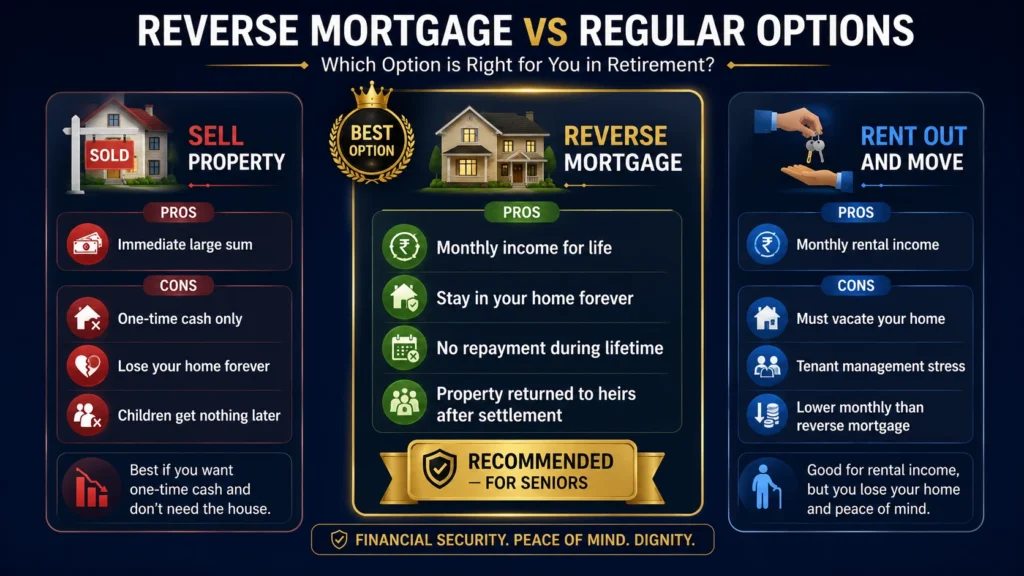
Many seniors consider multiple options for generating income from their property. Here is the honest comparison:
Option 1: Reverse Mortgage
Pros:
- Continue living in your home throughout your lifetime
- No monthly repayment obligation
- Predictable monthly income regardless of market conditions
- Non-recourse protection – heirs not liable beyond property
Cons:
- Monthly income may be lower than rental market value
- Interest accumulates – reducing equity left for heirs
- Limited lender options in India currently
- Property must be well-maintained throughout tenor
Option 2: Sell the Property and Invest
Pros:
- Immediate large capital sum
- Full flexibility on how to deploy the money
- Children can receive value immediately
Cons:
- Lose the home permanently – must arrange alternate accommodation
- Managing a large corpus requires financial sophistication
- Risk of outliving the invested corpus if returns disappoint
- Emotional cost of leaving a lifetime home
Option 3: Rent Out and Move to Smaller Accommodation
Pros:
- Retain property ownership and inheritance value
- Rental income can be substantial in good markets
Cons:
- Must vacate and find alternate accommodation
- Rental income is not guaranteed – tenant defaults, vacancies
- Landlord responsibilities and property management stress
- Moving at 65+ is physically and emotionally challenging
The Verdict: When Reverse Mortgage Wins
| Situation | Best Option |
|---|---|
| Want to stay in your home for life | Reverse Mortgage |
| Children abroad or financially independent | Reverse Mortgage or Sell |
| Children need inheritance urgently | Sell |
| Property in high-rental-yield area | Consider Rent Out carefully |
| Health issues requiring stable home | Reverse Mortgage strongly |
| Multiple properties owned | Reverse mortgage one, rent out other |
Tax Treatment of Reverse Mortgage Income
One of the most favourable aspects of reverse mortgage – the monthly income received is completely tax-free in the hands of the borrower:
| Income Component | Tax Treatment |
|---|---|
| Monthly reverse mortgage payments received | Tax-free – not treated as income |
| Lump sum received (if chosen) | Tax-free |
| Annuity income (LIC tie-up option) | Partially taxable as annuity income |
| Capital gains on property at settlement | Exempt for senior citizens if property is primary residence |
Under the Income Tax Act – the Supreme Court and tax authorities have consistently treated reverse mortgage payments as loan disbursements rather than income. This treatment makes reverse mortgage one of the only truly tax-free income streams available to senior citizens – unlike FD interest, rental income, or pension.
👉 Related Reading: Income Tax Calculator 2026 – Save Maximum Tax Legally → – understanding all senior citizen tax benefits alongside reverse mortgage.
Real Example: Mr. and Mrs. Patel’s Reverse Mortgage Journey
Profile: Retired couple, both aged 70 and 67, Ahmedabad. Own a 1,800 sq ft house valued at ₹65 lakhs. Pension: ₹9,000/month combined. Monthly expenses: ₹24,000. Monthly shortfall: ₹15,000.
Reverse Mortgage Calculation:
| Parameter | Value |
|---|---|
| Property Market Value | ₹65,00,000 |
| Bank Appraised Value | ₹58,00,000 (after 10.8% haircut) |
| LTV (50%) | ₹29,00,000 |
| Tenor Chosen | 15 years |
| Monthly Income Approved | ₹16,200/month |
Combined Monthly Income After Reverse Mortgage:
- Pension: ₹9,000
- Reverse Mortgage: ₹16,200
- Total: ₹25,200/month
Monthly expenses covered: ₹24,000 – covered with ₹1,200 surplus.
What happens in 15 years:
The loan balance outstanding at end of 15 years will be approximately ₹29,00,000 (principal) + accumulated interest at 9.5% = approximately ₹78,00,000.
Since the property is expected to appreciate to ₹1,30,00,000+ in 15 years (at 5% annual appreciation): the heirs can repay ₹78 lakhs and retain a property worth ₹1.3 crore – netting ₹52 lakhs. Or allow the bank to sell and receive the surplus.
Everyone wins: The Patels live with financial dignity for 15 years. The heirs ultimately still receive significant property inheritance.
Eligibility Checklist: Are You Eligible?
Before approaching a bank – confirm these eligibility requirements:
| Requirement | Status to Check |
|---|---|
| Age: Primary applicant must be 60+ years | |
| Property: Must be self-occupied residential | |
| Property ownership: Must be fully owned (no existing mortgage) | |
| Title: Must be clear – no disputes, liens, or encumbrances | |
| Property condition: Must be in good structural condition | |
| Property location: Must be in bank’s approved geography | |
| Residency: Must continue living in the property | |
| Indian citizenship: Required for most lenders |
If an existing home loan is outstanding: You cannot take a reverse mortgage until the existing loan is fully repaid – the property must be unencumbered. Some seniors use a portion of their savings to clear a small remaining home loan balance before applying for reverse mortgage.
The Application Process: Step by Step
Step 1 – Initial Assessment (Week 1)
Contact your preferred bank’s senior citizen service desk or home loan branch. Request a reverse mortgage information meeting. Bring: identity proof, property documents, title deed, and recent property tax receipts.
Step 2 – Property Valuation (Week 2-3)
The bank appoints an independent valuer who physically inspects and values the property. The appraised value – not your estimate or purchase price – determines the loan amount. Always request a copy of the valuation report.
Step 3 – Legal Verification (Week 2-3)
Bank’s legal team verifies property title chain – typically 15-30 years of ownership history. Clear title with documented chain processes fastest. Properties with disputed ownership or missing documents face delays or rejection.
Step 4 – Loan Sanction (Week 3-4)
Bank issues a sanction letter detailing: approved monthly income, tenor, interest rate, and conditions. Review all terms carefully – particularly the prepayment option for heirs and the property maintenance requirements.
Step 5 – Documentation and Disbursement (Week 4-5)
Sign the reverse mortgage agreement. Bank registers a charge on the property. Monthly income begins from the following month – credited directly to your bank account.
Step 6 – Ongoing Requirements
Property must be maintained in good condition throughout the tenor. Annual verification of residency and property condition is required by most banks. Property taxes and insurance must be kept current – failure to do so can trigger loan recall.
Important Protections for Senior Borrowers
India’s reverse mortgage framework includes several important consumer protections:
Protection 1 – Right to Stay: The borrower cannot be evicted or required to vacate the property during their lifetime – regardless of accumulated interest or loan balance growth.
Protection 2 – Non-Recourse Nature: If the loan balance at settlement exceeds the property value – the difference is absorbed by the lender. Heirs have no personal liability beyond the property.
Protection 3 – Cooling-Off Period: A mandatory cooling-off period (typically 3-7 days after signing) allows the borrower to cancel the agreement without penalty – important for ensuring seniors are not pressured into unsuitable products.
Protection 4 – Independent Legal Advice: Reputable banks require borrowers to obtain independent legal advice before signing – specifically to ensure the decision is voluntary and informed.
Protection 5 – Spouse Protection: If the primary borrower passes away – the surviving spouse can continue living in the property and receiving income without any disruption, provided they are a co-borrower.
Reverse Mortgage Across Developing Markets
| Country | Product Available | Regulator | Key Features |
|---|---|---|---|
| 🇮🇳 India | Yes – limited lenders | NHB | PSU bank-led; LIC annuity option |
| 🇵🇭 Philippines | Very limited | Bangko Sentral | Pilot programs only; not mainstream |
| 🇧🇷 Brazil | Yes – growing | Banco Central | Crédito com Garantia de Imóvel can be structured similarly |
| 🇿🇦 South Africa | Yes – available | NCR | Called “Home Reversion” or “Equity Release”; growing market |
| 🇬🇧 UK | Yes – well-developed | FCA | Called “Equity Release” or “Lifetime Mortgage”; mature market |
| 🇺🇸 USA | Yes – mainstream | HUD/FHA | Called HECM (Home Equity Conversion Mortgage); largest market globally |
The US HECM comparison: America’s FHA-backed Home Equity Conversion Mortgage is the global benchmark – with mandatory financial counselling, standardised terms, and government insurance protecting both borrowers and lenders. India’s reverse mortgage market is approximately where the US market was in the 1990s – present but not yet mainstream. Adoption will grow significantly as India’s population ages.
Common Misconceptions About Reverse Mortgage
Misconception 1: “The bank takes my house”
Reality: The bank registers a charge – like any secured loan – but you retain full ownership and the absolute right to live in the property for your lifetime. The bank can only act after you pass away or permanently vacate.
Misconception 2: “My children will get nothing”
Reality: In most cases, property appreciation over 15-20 years means the property at settlement is worth significantly more than the accumulated loan. Heirs receive the surplus after loan repayment – often lakhs of rupees.
Misconception 3: “I will pay tax on the monthly income”
Reality: Reverse mortgage payments are treated as loan disbursements – not income. They are completely tax-free in the hands of the senior citizen borrower.
Misconception 4: “The interest rate will keep rising and eat all my equity”
Reality: While interest accumulates – property appreciation generally outpaces the interest accumulation over 15-20 years in well-located Indian cities. The non-recourse protection also ensures the loan can never exceed property value.
Misconception 5: “Only people with no family should consider this”
Reality: Reverse mortgage is a completely legitimate financial planning tool regardless of family situation. Taking a reverse mortgage does not signal family abandonment – it signals smart asset utilisation that maintains the senior’s financial independence and dignity.
Frequently Asked Questions
Q: What happens to my reverse mortgage if I need to move to a nursing home or hospital for extended care?
A: If you permanently vacate the property – the reverse mortgage becomes due for repayment. However, temporary absence for medical treatment (typically up to 12 months) does not trigger repayment. If the absence becomes permanent – the loan is settled through property sale, with surplus going to your estate or heirs. Discuss long-term care scenarios explicitly with your lender before signing.
Q: Can I sell my property while a reverse mortgage is active?
A: Yes – you can sell the property at any time. The proceeds must first repay the outstanding reverse mortgage balance (principal + accumulated interest). Any surplus belongs to you. This gives you complete flexibility if you choose to downsize, relocate, or move to a care facility.
Q: What if my property value falls significantly after taking the reverse mortgage?
A: The non-recourse protection means you and your heirs are protected. Even if the property value falls below the outstanding loan amount at settlement – you (or your heirs) owe nothing beyond the property itself. The lender absorbs the shortfall. This protection is fundamental to reverse mortgage and is explicitly guaranteed under NHB guidelines.
Q: Can I take a reverse mortgage on a property I jointly own with my children?
A: No – the property must be solely owned by the borrower(s). Joint ownership with non-borrowing children disqualifies the property. If you currently hold joint ownership with a child – a deed change (with proper legal advice and stamp duty) to transfer full ownership to you may be considered before application.
Q: Is there a limit to how much monthly income I can receive?
A: There is no regulatory cap on monthly income – it is determined by your property value, LTV ratio, borrower age, and chosen tenor. However, most banks have practical limits tied to their maximum loan amounts (typically ₹50 lakhs to ₹1 crore of total loan). Very high-value properties may need to approach specialised lenders.
Q: Can I prepay a reverse mortgage if my financial situation improves?
A: Yes – most reverse mortgages allow partial or full prepayment without penalty. If children want to settle the loan and free the property from the charge – they can repay the outstanding balance at any time during the borrower’s lifetime or after their passing.
Conclusion
The reverse mortgage does not ask a senior citizen to give up their home. It does not ask them to leave. It does not ask their children to supplement their income month after month. It simply says: your home has financial value that can generate income today – while you continue to live in it, enjoy it, and eventually pass it to your heirs.
For millions of Indian seniors sitting in fully paid, valuable homes with insufficient monthly income – this instrument represents genuine financial dignity in retirement. Not charity. Not dependence. A financial product that converts a lifetime of property equity into a lifetime of monthly income.
The monthly income may not replace a full salary. But combined with pension, savings interest, and family support – it can eliminate the monthly shortfall that causes so much anxiety in the retirement years.
Calculate your number. Understand the terms. Have the family conversation. And make the decision with complete information rather than inherited misconception.
👉 Calculate your monthly reverse mortgage income with our free Reverse Mortgage Calculator →
👉 Related Reading: Retirement Corpus Calculator – How Much Do You Need to Retire? →
👉 Related Reading: Real Estate ROI Calculator – Is Property a Good Investment? →
👉 Related Reading: Mortgage Calculator – How Much Home Can You Afford? →
👉 Related Reading: Income Tax Calculator – Save Maximum Tax Legally →
👉 Related Reading: Fixed vs Floating Rate Mortgage – 10-Year Cost Comparison →
👉 Related Reading: Loan Against Property Calculator – Unlock Your Property’s Hidden Value →