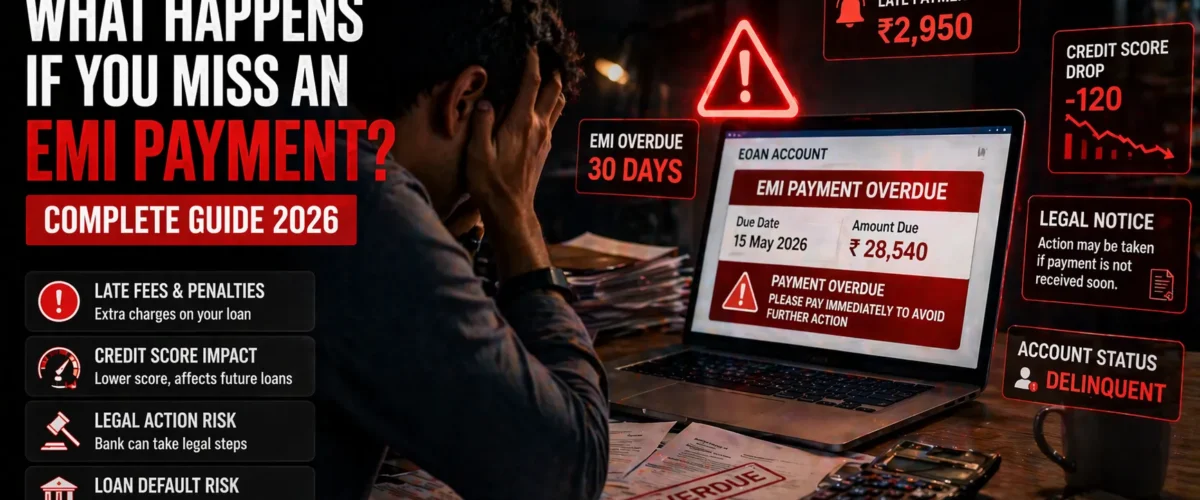
It happens to the best of us.
The salary was delayed by a week. An unexpected medical bill wiped out your account. A family emergency took everything you had. And now your EMI due date has silently passed.
What happens next? How bad is it, really? And what should you do in the next 24 hours?
The answer depends entirely on how long the EMI stays unpaid — and how quickly you act. Here is the complete, honest timeline of what happens after a missed EMI — and exactly what to do at each stage to protect yourself.
👉 If you’re worried about future EMI affordability, use our free Personal Loan EMI Calculator → to plan a more manageable loan structure.
Not All Missed EMIs Are Equal
Before the panic sets in, understand this: missing one EMI for a few days is very different from missing three EMIs over three months.
The banking system has a graduated response — early misses trigger reminders and small penalties, while prolonged defaults trigger legal machinery. Your goal is to act before the situation escalates past the first stage.
The Complete Timeline: What Happens Day by Day
| Time After Missed EMI | What Happens | Your Credit Score Impact | Severity |
|---|---|---|---|
| Day 1–3 | Bank sends SMS and email reminder. Auto-debit marked as failed. No formal action yet. | None | 🟡 Low |
| Day 3–7 | Bounce charge applied (₹200–₹1,500). First late payment fee charged. | None yet | 🟡 Low-Medium |
| Day 7–30 | Bank calls your registered mobile. Second late fee applied. Recovery team assigned. | Minor if reported | 🟠 Medium |
| Day 30 | Account officially reported to credit bureaus (CIBIL, Experian, Equifax). | -50 to -100 points | 🟠 Medium-High |
| Day 30–90 | Account marked Special Mention Account (SMA-0). Legal notice may be issued. Collection calls intensify. | -100 to -150 points | 🔴 High |
| Day 90 | Loan officially classified as Non-Performing Asset (NPA). Bank escalates to recovery division. | -150 to -200 points | 🔴 Very High |
| Day 90–180 | Recovery agents contacted. All new loan/credit card applications rejected across all lenders. | Severely damaged | 🔴 Critical |
| Day 180+ | Bank files legal suit. Seizure proceedings begin for secured loans (home, car). | Score may drop below 500 | 🔴 Severe |
The most important lesson from this table: the jump from Day 30 to Day 90 is catastrophic. Act before Day 30 at all costs.
The Financial Cost of One Missed EMI
Beyond the credit score damage, a missed EMI carries direct financial penalties that add up fast.
| Charge Type | Typical Amount | Notes |
|---|---|---|
| EMI Bounce Charge | ₹200–₹1,500 | Charged by lender for failed auto-debit |
| NACH/ECS Return Charge | ₹200–₹750 | Your own bank charges this separately |
| Late Payment Penalty | 2% per month on overdue EMI | Compounds until fully paid |
| Penal Interest | 1–3% per year on entire outstanding loan | Added on top of regular interest rate |
| Collection Visit Charges | ₹500–₹2,000 | Some loan contracts allow this |
| Total Cost of 1 Missed EMI (30 days) | ₹2,500–₹8,000+ | Depends on loan size and lender |
On a large home loan, a single missed EMI left unpaid for 30 days can cost ₹5,000–₹8,000 in penalties alone — on top of the original EMI you still owe.
Credit Score Impact — The Hidden Long-Term Damage
Missing an EMI hurts your credit score. But most people don’t realise how long that damage lasts.
| Situation | Score Drop | Recovery Time |
|---|---|---|
| 1 EMI missed, paid within 30 days | -50 to -80 points | 6–12 months |
| 1 EMI missed, paid within 60 days | -80 to -120 points | 12–18 months |
| 3+ EMIs missed (NPA classification) | -150 to -250 points | 24–36 months |
| Loan settled for less than full amount | -200 to -300 points | 36–48 months |
| Legal judgement against you | Score may drop to 300–400 | 5–7 years |
A credit score of 780 dropping to 580 after 3 missed EMIs means:
- All new loan applications rejected for 12–24 months
- Credit card limit slashed or card cancelled
- Higher interest rates on all future borrowing
- Home loan eligibility drops by ₹15–₹25 lakhs
👉 Related Reading: How Banks Calculate Your Home Loan Eligibility → — understand exactly what your credit score affects.
Secured vs Unsecured Loans — Very Different Risks
The type of loan you’ve missed matters enormously. Secured loans (where the bank holds your asset as collateral) carry far greater real-world consequences.
| Loan Type | Collateral | Bank’s Recovery Method | Legal Timeline |
|---|---|---|---|
| Home Loan | Your property | SARFAESI Act — bank can auction house after 60-day notice | 6–18 months after NPA |
| Car Loan | Your vehicle | Physical repossession of car | 3–6 months after NPA |
| Gold Loan | Your gold jewellery | Auction of pledged gold | 1–3 months after NPA |
| Personal Loan | None | Civil court suit, salary attachment order | 12–24 months after NPA |
| Education Loan | Co-signer liable | Legal action against co-signer and borrower | 12–18 months after NPA |
For home loans specifically — your house is at genuine risk after 90 days of non-payment under the SARFAESI Act. Banks are not sentimental about this.
👉 Related Reading: How to Reduce Your Home Loan EMI by 30% → — if your EMI is genuinely unaffordable, fix the structure before it becomes a default.
What To Do IMMEDIATELY After Missing an EMI
In the first 24–48 hours, do these 5 things:
Step 1 — Check your bank account balance right now. Sometimes EMI bounce happens due to insufficient funds in the wrong account. Transfer funds immediately and check if the bank will attempt auto-debit again (many banks retry in 2–3 days).
Step 2 — Call your lender proactively — before they call you. This single action prevents escalation more than anything else. Tell them what happened, confirm when you will pay, and ask if they can waive the bounce charge given your track record. Most banks will accommodate a first-time issue for a good customer.
Step 3 — Pay the overdue EMI + all penalties as fast as possible. Even 5 days late is dramatically better than 30 days late. Every day you delay adds penalties and increases credit score damage.
Step 4 — Ask about a short-term EMI moratorium if you genuinely cannot pay. Many banks offer a temporary 1–3 month payment holiday for borrowers facing genuine financial hardship — medical emergency, job loss, natural disaster. Interest continues to accrue but you avoid default classification.
Step 5 — Keep a written record of everything. Every call, every payment, every message. If there is ever a dispute about default dates or charges, this documentation protects you.
If You Know in Advance You Will Miss an EMI
This is actually the best situation — you have time to act before the miss happens.
- Call your bank at least 7 days before the due date. Explain your situation. Ask for a due date extension or moratorium.
- Request a loan restructuring. If your current EMI is genuinely unaffordable, ask the bank to formally restructure — extend tenure, reduce EMI, or convert to a step-down structure.
- Make a partial payment. Even paying half the EMI shows good faith and may prevent bounce charges and credit bureau reporting.
- Use a personal loan or credit card as a bridge. If this is a one-time cash flow gap, a small personal loan or credit card payment to cover the EMI can protect your credit score. Just ensure you repay it quickly.
👉 Related Reading: Personal Loan vs Credit Card — Which Is Cheaper? → — compare your bridge financing options before choosing.
What Happens to a Co-Applicant or Guarantor?
If your loan has a co-applicant (like a spouse) or a guarantor (like a parent), their credit score is also damaged by your default — even though they didn’t miss any payment themselves.
The bank will contact the co-applicant or guarantor and demand payment after a defined period. Their CIBIL report will show the same default as yours. This is why adding someone as a guarantor or co-applicant is a serious responsibility — and why they need to know the full picture of your financial health.
Can You Recover Your Credit Score After a Default?
Yes — but it takes time and discipline. Here is a realistic recovery timeline:
| Action | Timeline | Impact |
|---|---|---|
| Clear all overdue EMIs and penalties | Immediately | Stops further damage |
| Credit bureau updated after payment | 30–45 days | Report shows “settled” or “paid” |
| Score starts recovering | Month 3–6 | +20–40 points per month with clean repayments |
| Score reaches pre-default level | 12–36 months | Depends on severity of default |
Active recovery steps:
- Pay every EMI on time without a single miss going forward
- Reduce credit card utilisation to below 30% of your limit
- Dispute any errors in your CIBIL report through the official CIBIL dispute portal
- Do not apply for multiple loans during recovery — each hard inquiry drops your score further
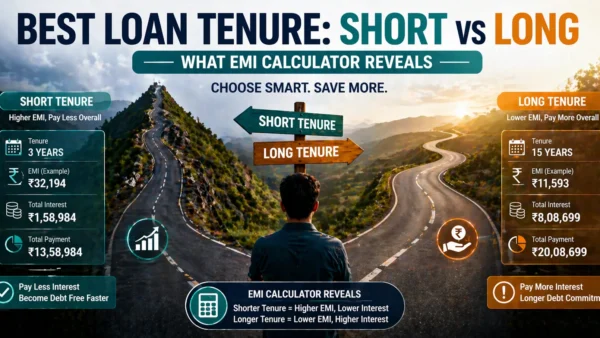
👉 Related Reading: Best Loan Tenure — Short vs Long EMI Calculator → — restructure your loans to an EMI you can comfortably sustain.
The ₹500 Rule: Your Personal EMI Safety Net
Here is a simple rule that prevents most EMI defaults before they happen:
Always keep a minimum buffer of 2 full EMIs in your salary account at all times.
On a ₹12,000 EMI, that means maintaining a minimum ₹24,000 balance specifically for loan repayments — separate from your daily spending account. This single habit prevents 90% of accidental defaults caused by cash flow timing issues.
EMI Default Risk by Country — What to Know
| Country | Credit Bureau | Default Classification | Key Legal Act |
|---|---|---|---|
| 🇮🇳 India | CIBIL, Experian, Equifax, CRIF | NPA after 90 days | SARFAESI Act (secured loans) |
| 🇵🇭 Philippines | CIC (Credit Information Corp) | Past due after 30 days | Act 3135 (mortgage foreclosure) |
| 🇳🇬 Nigeria | CRC Credit Bureau | Default after 90 days | Banks and Other Financial Institutions Act |
| 🇧🇷 Brazil | Serasa Experian | SPC/Serasa negative listing after 5 days | Law 4728 (secured assets) |
| 🇰🇪 Kenya | CRB (Credit Reference Bureau) | Listed after 90 days | Banking Act Cap 488 |
In all these markets, the damage to your credit record lasts 5–7 years even after the debt is fully repaid. Prevention is always cheaper than cure.
Frequently Asked Questions
Q: Will one missed EMI ruin my credit score permanently? A: No. A single missed EMI paid within 30 days causes temporary damage of 50–80 points that typically recovers within 6–12 months of consistent repayment. The key is acting within the first 30 days — before the bureau reporting kicks in.
Q: Can the bank take my house for missing just one EMI? A: No. Banks require a minimum of 90 consecutive days of non-payment (NPA classification) before initiating any legal proceedings under SARFAESI. Even after that, a formal 60-day notice must be issued before any auction proceedings begin.
Q: What is an EMI moratorium and does it affect credit score? A: A moratorium is a bank-approved temporary pause on EMI payments — usually offered during proven financial hardship. An officially approved moratorium does NOT negatively affect your credit score. However, interest continues to accrue during the pause, increasing your total outstanding amount.
Q: I missed 3 EMIs. Is it too late to fix this? A: No — but you must act immediately. Contact your bank today, explain your situation honestly, and ask for restructuring. Paying all 3 overdue EMIs at once is ideal. If you cannot, negotiate a repayment plan. Banks strongly prefer restructuring over the lengthy and expensive legal recovery process.
Q: Does missing an EMI affect my other loans or credit cards? A: Not directly — each loan is reported separately. However, if your credit score drops significantly, lenders may proactively reduce your credit card limits or reject future loan applications based on your overall credit report.
Conclusion
Missing an EMI is stressful — but it is rarely catastrophic if you act immediately and honestly.
The worst outcomes in EMI default always happen to one type of borrower: the person who ignores the problem, avoids bank calls, and hopes it goes away. It never goes away. It only compounds.
The best outcome happens when you call your bank within 24 hours, pay as quickly as possible, and ask for help if you genuinely need it.
If you’re concerned your current EMI is too high for your income, the smartest move is to fix the structure now — before it ever becomes a problem.
👉 Use our free EMI Calculator → to find a monthly payment that comfortably fits your income. 👉 Check your loan restructuring options with our Home Loan Refinance Calculator → 👉 Related Reading: How to Reduce Your Home Loan EMI by 30% → 👉 Related Reading: EMI vs Lump Sum Repayment — Which Saves More? →