Every year, millions of salaried individuals across India do the same thing in February or March:
They panic.
They scramble to make last-minute investments, submit hastily chosen insurance policies to their employer, and end up paying far more in tax than they legally have to — simply because they never planned ahead.
Here is the uncomfortable truth: most salaried employees overpay income tax by ₹30,000 to ₹1,50,000 every year. Not because tax laws are unfair. But because they do not know which deductions they are entitled to — or they know but leave it until it is too late to fully utilise them.
This guide changes that. You will learn the exact 2026 tax slabs, every major legal deduction available, the new vs old regime comparison, and the complete strategy for paying only what you are legally required to pay — not a rupee more.
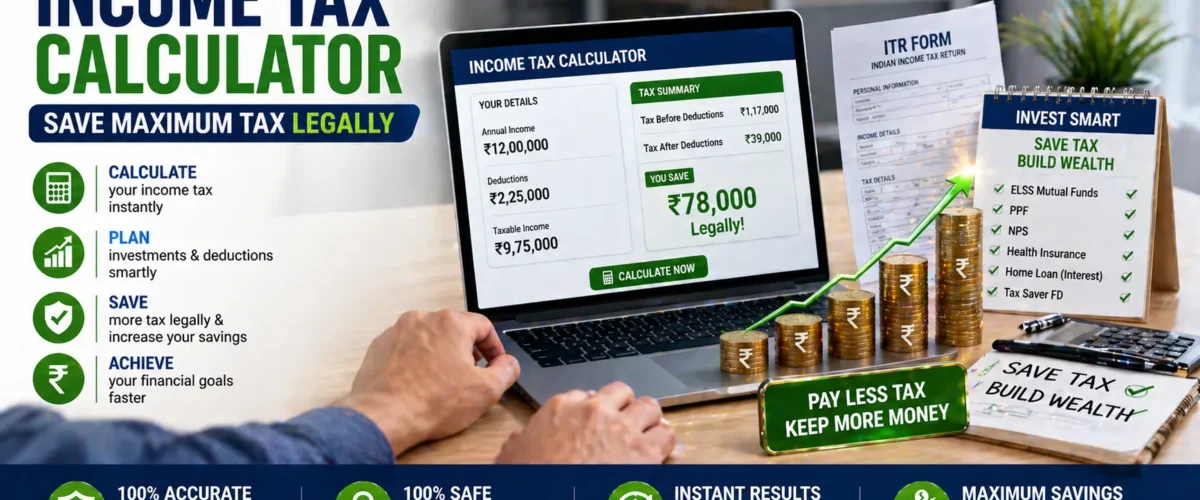
👉 Calculate your exact 2026 income tax liability with our free Income Tax Calculator →
The Two Tax Regimes: Your First and Most Important Decision
Since FY 2020–21, Indian taxpayers have had a choice between two completely different income tax systems. This is the first decision you must make — and it determines everything else.
The New Tax Regime (Default from FY 2023–24)
Lower tax rates across all slabs — but with most deductions and exemptions removed. Simpler, but potentially more expensive if you have significant investments, home loan, or HRA.
The Old Tax Regime (Must Opt-In)
Higher slab rates — but allows 70+ deductions and exemptions. More complex, but potentially saves significantly more tax for individuals with investments, home loans, and structured salary.
The new regime became the default from FY 2023–24 onwards. If you do nothing — you are automatically on the new regime. To use the old regime, you must explicitly opt in when filing your ITR or submitting declaration to your employer.
Income Tax Slabs 2026: New Regime vs Old Regime
New Tax Regime Slabs (FY 2026–27 — Budget 2026 Updated)
| Income Slab | Tax Rate |
|---|---|
| Up to ₹4,00,000 | Nil |
| ₹4,00,001 – ₹8,00,000 | 5% |
| ₹8,00,001 – ₹12,00,000 | 10% |
| ₹12,00,001 – ₹16,00,000 | 15% |
| ₹16,00,001 – ₹20,00,000 | 20% |
| ₹20,00,001 – ₹24,00,000 | 25% |
| Above ₹24,00,000 | 30% |
Note: Section 87A rebate makes income up to ₹12,00,000 effectively tax-free under the new regime after the rebate. Standard deduction of ₹75,000 also available under new regime.
Old Tax Regime Slabs (FY 2026–27)
| Income Slab | Tax Rate |
|---|---|
| Up to ₹2,50,000 | Nil |
| ₹2,50,001 – ₹5,00,000 | 5% |
| ₹5,00,001 – ₹10,00,000 | 20% |
| Above ₹10,00,000 | 30% |
Note: Section 87A rebate of ₹12,500 available for income up to ₹5,00,000. Standard deduction of ₹50,000 available.
Surcharge and Cess (both regimes):
- Health and Education Cess: 4% on tax payable
- Surcharge: 10% (income ₹50L–₹1Cr), 15% (₹1Cr–₹2Cr), 25% (₹2Cr–₹5Cr), 37% (above ₹5Cr)
👉 Calculate your exact tax under both regimes instantly with our free Income Tax Calculator →
New Regime vs Old Regime: Which Saves You More?
This is the most important annual tax decision for every salaried individual. The answer depends entirely on your total eligible deductions:
The Break-Even Deduction: When Old Regime Wins
The old regime is beneficial when your total deductions exceed a certain threshold. Here is the break-even analysis:
| Annual Income | Break-Even Deduction (Old regime becomes beneficial) |
|---|---|
| ₹8,00,000 | ₹1,25,000+ in deductions |
| ₹10,00,000 | ₹1,87,500+ in deductions |
| ₹12,00,000 | ₹3,12,500+ in deductions |
| ₹15,00,000 | ₹3,75,000+ in deductions |
| ₹20,00,000 | ₹4,37,500+ in deductions |
If your total deductions exceed these thresholds — old regime saves more money. If below — new regime is simpler and cheaper.
Side-by-Side Comparison: ₹15 Lakh Annual Income
| Scenario | New Regime | Old Regime (With Deductions) |
|---|---|---|
| Gross Income | ₹15,00,000 | ₹15,00,000 |
| Standard Deduction | −₹75,000 | −₹50,000 |
| Section 80C (PPF + ELSS + EPF) | Not available | −₹1,50,000 |
| Home Loan Interest (24b) | Not available | −₹2,00,000 |
| NPS (80CCD 1B) | Not available | −₹50,000 |
| Health Insurance (80D) | Not available | −₹25,000 |
| HRA Exemption | Not available | −₹96,000 (estimated) |
| Taxable Income | ₹14,25,000 | ₹8,29,000 |
| Tax Payable (before cess) | ₹1,73,750 | ₹78,200 |
| Tax After 4% Cess | ₹1,80,700 | ₹81,328 |
| TAX SAVING WITH OLD REGIME | ₹99,372 |
With a home loan, investments, and health insurance — the old regime saves nearly ₹1 lakh on a ₹15 lakh income. This is why the choice between regimes is the highest-leverage tax decision you make every year.
Every Major Tax Deduction Available Under the Old Regime
Section 80C: The ₹1.5 Lakh Powerhouse
The most widely used deduction — allows up to ₹1,50,000 annually across a basket of qualifying investments and payments:
| 80C Investment/Payment | Annual Limit | Returns | Lock-in | Best For |
|---|---|---|---|---|
| ELSS Mutual Funds | Within ₹1.5L | 12–15% (market) | 3 years | Wealth building + tax saving |
| PPF | Within ₹1.5L | 7.1% (guaranteed) | 15 years | Risk-averse long-term saving |
| EPF (Employee Contribution) | Within ₹1.5L | 8.15% (guaranteed) | Until retirement | Auto-deducted from salary |
| Life Insurance Premium | Within ₹1.5L | Varies | Policy term | If genuine insurance need |
| Tax-Saving FD | Within ₹1.5L | 6.5–7.5% | 5 years | Conservative saving |
| NSC | Within ₹1.5L | 7.7% | 5 years | Safe government-backed |
| SCSS (Senior Citizens) | Within ₹1.5L | 8.2% | 5 years | Age 60+ only |
| Home Loan Principal | Within ₹1.5L | — | — | If repaying home loan |
| Tuition Fees (2 children) | Within ₹1.5L | — | — | School/college fees |
| Sukanya Samriddhi | Within ₹1.5L | 8.2% | Until daughter turns 21 | For girl child |
Pro tip: Most salaried employees already have EPF deductions that partially fill the ₹1.5 lakh limit. Calculate your annual EPF contribution first — then invest the remaining amount in ELSS or PPF for the best combination of return and flexibility.
👉 Related Reading: Tax-Saving Investment Calculator — 5 Best Options for 2026 → — the complete comparison of all Section 80C investment options.
Section 24(b): Home Loan Interest — Up to ₹2 Lakh
If you have a home loan, Section 24(b) allows you to deduct up to ₹2,00,000 per year in mortgage interest paid — one of the most valuable deductions available to salaried borrowers.
| Loan Type | Maximum Deduction | Condition |
|---|---|---|
| Self-occupied property | ₹2,00,000/year | Loan taken for purchase/construction |
| Let-out property | No upper limit | Entire interest deductible |
| Under-construction (pre-possession) | Deductible in 5 equal parts post-possession | Construction must complete within 5 years |
On a ₹40 lakh home loan at 8.5%, year 1 interest is approximately ₹3.28 lakhs. You can deduct ₹2 lakhs of this — saving ₹62,400 in tax for a 30% bracket taxpayer.
For a joint home loan with a working spouse, both co-owners claim ₹2 lakhs each — saving ₹1,24,800 combined in the 30% bracket.
👉 Related Reading: How to Save Tax Using Home Loan — Complete Guide → — every home loan tax benefit explained in complete detail.
Section 80D: Health Insurance — Up to ₹1 Lakh
Health insurance premiums qualify for tax deduction — and the limits are generous enough to cover most family’s realistic insurance costs:
| Who is Covered | Maximum Deduction | Notes |
|---|---|---|
| Self + Spouse + Children (below 60) | ₹25,000 | Annual premium paid |
| Self + Spouse + Children (you are 60+) | ₹50,000 | Senior citizen limit |
| Parents (below 60) | Additional ₹25,000 | On top of self coverage |
| Parents (60 or above) | Additional ₹50,000 | Highest combined benefit |
| Maximum Combined (self below 60, parents above 60) | ₹75,000 | Both limits combined |
| Maximum Combined (self above 60, parents above 60) | ₹1,00,000 | Both senior limits |
A family with parents aged 60+ paying ₹25,000 for own health insurance and ₹45,000 for parents’ health insurance claims ₹70,000 in Section 80D deductions — saving ₹21,840 in tax at 30% bracket + cess.
Section 80CCD(1B): NPS Extra Deduction — ₹50,000 Over and Above 80C
The National Pension System allows an additional ₹50,000 deduction beyond the ₹1.5 lakh Section 80C limit — exclusively for NPS Tier 1 contributions.
This is the most underutilised tax deduction available to salaried individuals:
| Bracket | Tax Saving from Extra ₹50,000 NPS Deduction |
|---|---|
| 20% bracket | ₹10,400 (including cess) |
| 30% bracket | ₹15,600 (including cess) |
Combined with Section 80C, NPS Tier 1 contributions allow total deductions of ₹2,00,000 — saving ₹62,400 at the 30% bracket from these two sections alone.
The NPS strategy: Even if you prefer ELSS over NPS for wealth building, contributing the minimum ₹6,000/year to NPS Tier 1 qualifies you for 80CCD(1B) — then claiming the full ₹50,000 deduction either through that ₹6,000 minimum plus additional contributions, or by maximising the contribution up to ₹50,000 annually.
HRA Exemption: Tax-Free Portion of House Rent Allowance
If your salary includes HRA and you live in rented accommodation, a significant portion of your HRA is tax-exempt:
HRA Exemption = Minimum of the following three:
1. Actual HRA received from employer
2. 50% of basic salary (metro cities: Delhi, Mumbai, Kolkata, Chennai)
   OR 40% of basic salary (non-metro cities)
3. Actual rent paid − 10% of basic salary

Example:
Basic Salary: ₹40,000/month
HRA Received: ₹20,000/month
Monthly Rent Paid: ₹18,000
City: Mumbai (metro)

Calculation:
Option 1: ₹20,000 (actual HRA)
Option 2: ₹20,000 (50% of basic)
Option 3: ₹18,000 − ₹4,000 = ₹14,000 (rent − 10% basic)

HRA Exemption = ₹14,000/month = ₹1,68,000/year
Tax Saved (30% bracket): ₹52,416/year
Critical requirement: Rent must actually be paid. Landlord’s PAN is required for annual rent above ₹1,00,000. Fictitious rent claims are a major audit trigger — always maintain genuine rental agreements and payment evidence.
Leave Travel Allowance (LTA): Tax-Free Travel
LTA exemption allows you to claim actual travel expenses for domestic travel — twice in a block of 4 years (current block: 2022–2026):
- Only domestic travel qualifies — no international travel exemption
- Only transport costs (air, rail, road) qualify — hotel and food do not
- Exemption is for the shortest route to the destination
- Family (spouse, children, parents) travel costs qualify
LTA optimisation tip: Submit LTA claims in January/February when planning your annual travels — this reduces your TDS for the remainder of the financial year. Many employees forget to submit and lose the exemption entirely.
Section 80E: Education Loan Interest — No Upper Limit
If you have taken an education loan for yourself, spouse, children, or a student for whom you are the legal guardian — the entire interest paid is deductible with no upper limit, for up to 8 years from when repayment begins.
On a ₹15 lakh education loan at 10%, year 1 interest of approximately ₹1,45,000 is fully deductible — saving ₹45,240 in tax at 30% bracket.
Section 80G: Charitable Donations — 50% to 100% Deductible
Donations to approved charitable organisations qualify for 50–100% deduction depending on the type of institution:
| Donation Type | Deduction % | Notes |
|---|---|---|
| PM Relief Fund, PMNRF | 100% | No qualifying limit |
| Approved charitable trusts | 50% | Subject to 10% of adjusted gross income cap |
| Political parties | 100% | Via electoral bonds |
| Swachh Bharat Kosh | 100% | Government scheme |
Donations above ₹2,000 in cash do not qualify — must be made by cheque, online transfer, or DD.
The Complete Tax Saving Strategy: Maximise Every Deduction
Here is the optimal sequencing for maximising deductions under the old regime:
Step 1 — Standard Deduction (₹50,000): Automatic No action required — automatically applied to all salaried individuals.
Step 2 — Section 80C (₹1,50,000): Maximise First Check your EPF contribution (already counts toward 80C). Top up with ELSS SIP for the remaining amount — best combination of returns and flexibility.
Step 3 — Section 80CCD(1B) (₹50,000): NPS Second Open NPS Tier 1 account if not already done. Contribute ₹50,000 annually — exclusively for this extra deduction. This saves ₹15,600 at 30% bracket.
Step 4 — Section 24(b) (₹2,00,000): Home Loan Interest If you have a home loan, ensure the full ₹2,00,000 interest deduction is claimed. Submit loan interest certificate from your bank to your employer by January.
Step 5 — Section 80D (₹25,000–₹1,00,000): Health Insurance Buy comprehensive health insurance for self and family if you do not have it. This doubles as essential financial protection AND a significant tax deduction.
Step 6 — HRA Exemption: Submit Rent Receipts If you live on rent and receive HRA — submit rent receipts and landlord PAN to your employer by December–January. Do not skip this step — it is one of the largest available exemptions.
Step 7 — LTA (₹25,000–₹50,000+): Claim Travel Submit LTA claim with travel tickets when filing — ensure you have traveled at least twice in the 4-year block.
Combined Maximum Deductions Available:
| Deduction | Maximum Amount |
|---|---|
| Standard Deduction | ₹50,000 |
| Section 80C | ₹1,50,000 |
| Section 80CCD(1B) NPS | ₹50,000 |
| Section 24(b) Home Loan Interest | ₹2,00,000 |
| Section 80D Health Insurance | ₹75,000 (self below 60, parents above 60) |
| HRA Exemption | Varies — typically ₹1,00,000–₹2,00,000 |
| LTA | Varies — typically ₹25,000–₹50,000 |
| TOTAL MAXIMUM DEDUCTIONS | ₹6,00,000–₹7,25,000 |
For a ₹20 lakh income with maximum deductions, taxable income falls to ₹13,00,000–₹14,00,000 — potentially saving ₹1,50,000–₹2,00,000 in annual tax.
Complete Tax Calculation Example: ₹18 Lakh Annual Income
Let us walk through a complete calculation showing old vs new regime with realistic deductions:
Profile: Salaried professional, ₹18 lakh CTC, Mumbai, home loan, health insurance, NPS contributor
| Item | New Regime | Old Regime |
|---|---|---|
| Gross Annual Income | ₹18,00,000 | ₹18,00,000 |
| Standard Deduction | −₹75,000 | −₹50,000 |
| HRA Exemption | Not available | −₹1,68,000 |
| Section 80C (ELSS + EPF) | Not available | −₹1,50,000 |
| Section 24(b) Home Loan Interest | Not available | −₹2,00,000 |
| Section 80D Health Insurance | Not available | −₹45,000 |
| Section 80CCD(1B) NPS | Not available | −₹50,000 |
| Net Taxable Income | ₹17,25,000 | ₹10,37,000 |
| Tax on Taxable Income | ₹2,11,250 | ₹1,07,400 |
| Health & Education Cess (4%) | ₹8,450 | ₹4,296 |
| Total Tax Payable | ₹2,19,700 | ₹1,11,696 |
| Annual Tax Saving (Old Regime) | ₹1,08,004 |
The old regime saves ₹1,08,004 per year on an ₹18 lakh income with realistic deductions. That is over ₹9,000 per month — money that could fund an additional ₹9,000 SIP contribution, accelerating wealth building simultaneously with tax saving.
👉 Compare your old vs new regime tax with our free Income Tax Calculator →
The Investment Declaration Trap: Why Timing Matters
Most employees submit their investment declarations to HR/payroll in April (beginning of financial year) — and then forget. By January, when the employer asks for proof, they scramble.
The correct approach:
April–May: Submit your investment declaration with planned amounts for the full year. This sets your TDS deduction at the optimal level immediately.
October–November: Review actual investments made so far. Adjust declaration if needed.
January–February: Submit all proof documents — rent receipts, loan interest certificate, insurance premium receipts, investment statements, LTA claims.
March 31: Hard deadline — all tax-saving investments for FY 2024–25 must be completed by this date. No extensions.
The cost of missing March 31: You lose the deduction entirely for that financial year. There is no grace period. Investments made on April 1 count for the next financial year only.
Tax Planning Calendar: Month-by-Month Action Plan
| Month | Action | Why It Matters |
|---|---|---|
| April | Submit investment declaration to employer | Sets optimal TDS from April onwards |
| May–June | Open NPS Tier 1 if not already done | ₹50,000 extra deduction available |
| July | File ITR for previous year (deadline July 31) | Avoid late filing fees |
| August–September | Review investment progress vs plan | Course-correct if behind schedule |
| October | Start ELSS SIP if not started — 6 months of investment before March | Avoid lump sum March rush |
| November | Review health insurance coverage | Renew before expiry; claim deduction |
| December | Submit rent receipts for HRA if paying rent | Critical — do not miss this |
| January | Submit home loan interest certificate | Bank issues annually; submit to employer |
| February | Submit all investment proofs to employer | Final TDS revision by employer |
| March 31 | Complete all remaining investments (PPF top-up, LIC premium, ELSS) | Hard deadline — no exceptions |
Income Tax for Self-Employed and Freelancers
Self-employed individuals and freelancers face a different tax structure — but the same deduction principles apply:
Key differences from salaried:
- No TDS — must pay advance tax in four installments (June 15, September 15, December 15, March 15)
- No standard deduction — but business expenses are deductible
- No employer EPF — but can contribute to PPF and NPS voluntarily
- Must maintain books of accounts if income exceeds ₹25 lakhs (professional) or ₹1 crore (business)
- Presumptive taxation under Section 44ADA (professional services, income up to ₹50L): 50% of gross receipts deemed as income — no audit required
Section 44ADA Example:
Freelance income: ₹20,00,000
Presumptive income (50%): ₹10,00,000
Tax on ₹10,00,000 (old regime, after 80C etc): ₹75,000 approx

vs

Actual expenses tracked: ₹8,00,000
Taxable income: ₹12,00,000
Tax: ₹1,24,800

→ Section 44ADA better here (saves ₹49,800 + no expense tracking burden)
Always compare actual expense method vs presumptive taxation — choose whichever produces the lower tax for your specific income and expense profile.
Income Tax Across Developing Markets: Global Comparison
Understanding how India’s tax system compares with peer developing markets provides useful context:
| Country | Tax-Free Income Threshold | Top Marginal Rate | Notable Feature |
|---|---|---|---|
| 🇮🇳 India | ₹12,00,000 (new regime with rebate) | 30% + 37% surcharge | Two regime choice; extensive deductions |
| 🇵🇭 Philippines | ₱250,000 (~₹3,75,000) | 35% | TRAIN Law reformed rates in 2018 |
| 🇳🇬 Nigeria | ₦300,000 (~₹1,35,000) | 24% | Personal Income Tax Act; PAYE system |
| 🇧🇷 Brazil | R$28,559 (~₹4,28,000) annually | 27.5% | Complex system; IRPF annual filing |
| 🇰🇪 Kenya | KSh 288,000 (~₹1,73,000) annually | 35% | PAYE automatic; personal relief ₹2,400/month |
| 🇵🇰 Pakistan | PKR 600,000 (~₹1,62,000) | 35% | Progressive slabs; many exemptions for salaried |
India’s new regime effectively makes ₹12 lakhs tax-free — one of the highest thresholds among developing markets in absolute terms. The combination of this threshold with Section 87A rebate makes India’s income tax system relatively benign for middle-income earners compared to Brazil and Philippines.
The Most Common Income Tax Mistakes — and How to Avoid Them
Mistake 1 — Defaulting to New Regime Without Comparing The new regime is the default — but for most salaried individuals with a home loan, investments, and HRA, the old regime saves significantly more. Always run the comparison using our calculator before declaring your regime choice.
Mistake 2 — Not Claiming HRA Because Rent Is Paid to Parents If you pay rent to your parents (who own the property) — you CAN claim HRA exemption. Your parents declare the rental income. Both benefit: you get HRA exemption, they pay tax on rental income which may be at a lower rate or covered by their basic exemption. This is completely legal and widely practiced.
Mistake 3 — Missing the NPS Extra Deduction Section 80CCD(1B) provides ₹50,000 additional deduction that most taxpayers leave completely unclaimed. At 30% bracket + cess, this saves ₹15,600 annually — for contributing ₹50,000 to NPS which is your own retirement savings anyway.
Mistake 4 — Not Submitting Proof on Time Investment declarations without proof submission result in employer deducting TDS on full income. Proofs must be submitted by January–February. Late or missing proof means the deduction is not reflected in TDS — and you must claim the refund during ITR filing, which delays the benefit.
Mistake 5 — Ignoring Form 26AS and AIS Before filing ITR, always verify Form 26AS (TDS credit) and Annual Information Statement (AIS) — which show all income, TDS deducted, and financial transactions reported against your PAN. Discrepancies between ITR and AIS trigger automated notices. Reconcile before filing.
Mistake 6 — Missing the July 31 ITR Deadline Late ITR filing attracts a penalty of ₹5,000 (₹1,000 for income below ₹5 lakhs). More importantly, certain losses (capital losses, business losses) cannot be carried forward if ITR is filed late. File by July 31 without exception.
Salary Structure Optimisation: How to Reduce Tax Through Your CTC Design
For employees with flexible salary structuring (common in private sector), restructuring your CTC components can significantly reduce taxable income:
| CTC Component | Taxability | Optimisation |
|---|---|---|
| Basic Salary | Fully taxable | Keep at 40–50% of CTC (higher basic = higher HRA but also higher taxable) |
| HRA | Partially exempt | Maximise to 50% of basic (metro) |
| LTA | Exempt for actual travel | Include in CTC and claim |
| Medical Reimbursement | ₹15,000 exempt (old regime) | Include if employer offers |
| Food Coupons/Allowance | ₹50/meal, ₹26,400/year exempt | Utilise if offered |
| Mobile/Internet Reimbursement | Exempt for actual use | Submit bills for full exemption |
| NPS Employer Contribution (80CCD 2) | Exempt up to 10% of basic | Employer’s NPS contribution is entirely tax-free — ask HR |
The NPS employer contribution exemption (Section 80CCD 2) is particularly powerful: if your employer contributes up to 10% of your basic salary to NPS on your behalf — this is completely exempt from tax with no upper limit. On a ₹60,000 basic salary, a 10% employer NPS contribution (₹6,000/month = ₹72,000/year) is fully exempt — saving ₹22,464 in additional tax at the 30% bracket. This is a restructuring available to many private sector employees — worth discussing with HR.
Filing Your Income Tax Return: The Essentials
Who must file ITR:
- Total income exceeds ₹2.5 lakhs (old regime threshold) or ₹3 lakhs (new regime threshold) — before deductions
- TDS has been deducted from your income (filing mandatory to claim refund)
- You have capital gains, foreign assets, or multiple income sources
Which ITR Form:
- ITR-1 (Sahaj): Salaried with income up to ₹50 lakhs, one house property, no business income
- ITR-2: Capital gains, more than one property, foreign income
- ITR-3: Business or professional income
- ITR-4 (Sugam): Presumptive business/professional income
Filing deadline: July 31 for most individuals (extended occasionally). September 30 for accounts requiring audit.
Key documents for filing:
- Form 16 (TDS certificate from employer)
- Form 16A (TDS on other income — interest, rent, etc.)
- Bank statements for interest income
- Investment proof for claimed deductions
- Capital gains statement from broker
- Home loan certificate from bank
👉 Calculate your exact refund or tax due with our Income Tax Calculator →
Frequently Asked Questions
Q: What is the income tax-free limit in 2026? A: Under the new tax regime — income up to ₹12,00,000 is effectively tax-free after the Section 87A rebate of ₹60,000 (Budget 2026 update). The standard deduction of ₹75,000 also applies, making gross income up to ₹12,75,000 potentially tax-free. Under the old regime — income up to ₹5,00,000 is tax-free after the ₹12,500 rebate.
Q: Can I switch between new and old regime every year? A: Yes — salaried individuals can switch between regimes every financial year at the time of filing ITR. However, if you have business income — you can switch from old to new regime only once; switching back is not allowed. Decide at the beginning of each financial year based on your investment plans for that year.
Q: Which is better — ELSS or PPF for tax saving? A: ELSS has the shortest lock-in (3 years), highest potential returns (12–15%, market-linked), and is ideal for long-term wealth building alongside tax saving. PPF has a 15-year lock-in but provides guaranteed 7.1% tax-free returns — ideal for risk-averse investors building retirement corpus. For most working professionals under 45, ELSS is the better choice for the growth potential. For investors approaching retirement or with very low risk tolerance, PPF provides certainty. A combination of both is often optimal.
Q: Is there any tax benefit on home loan principal repayment? A: Yes — principal repaid during the year qualifies for Section 80C deduction, subject to the overall ₹1.5 lakh limit. This is shared with EPF, ELSS, PPF, and other 80C instruments. On a typical home loan, the principal repayment in early years is small (₹60,000–₹90,000) — so home loan principal alone rarely fills the entire ₹1.5 lakh limit. Only available under the old tax regime.
Q: What happens if I do not file ITR? A: Penalties apply — ₹5,000 late filing fee (₹1,000 for income under ₹5L). Certain losses cannot be carried forward. Refunds are delayed. For incomes above ₹50 lakhs, non-filing can trigger scrutiny notices. Additionally, ITR is required documentation for home loans, visa applications, and many financial products — making it essential beyond just legal compliance.
Q: My employer deducted excess TDS. How do I get a refund? A: File your ITR with all deductions claimed. If your actual tax liability (after all deductions) is lower than TDS deducted — the excess is shown as refund in your ITR. After ITR processing (typically 15–45 days post e-verification), the refund is credited to your bank account linked with ITR. Always verify your bank account details and ensure the account is linked to your PAN for fastest refund processing.
Conclusion
Income tax planning is not a once-a-year panic — it is a 12-month discipline that determines how much of your hard-earned income stays in your own hands.
The two decisions that matter most:
Decision 1 — Choose the right regime: Run the old vs new regime comparison using our calculator. For most salaried individuals with a home loan, investments, and HRA — the old regime saves ₹50,000 to ₹1,50,000 annually.
Decision 2 — Start investing in April, not March: The March rush leads to suboptimal decisions, wrong products chosen for wrong reasons, and unnecessarily high TDS throughout the year. Start your ELSS SIP in April. Open NPS in May. Submit your declaration in June. And arrive at March 31 with everything already done — calmly.
Every rupee of legal tax saved is a rupee that compounds in your SIP, reduces your home loan faster, or funds your family’s financial security. The Income Tax Act provides these deductions precisely because the government wants to incentivise savings, investment, and home ownership.
Use every deduction you are entitled to. Not as tax evasion — but as informed, responsible financial citizenship.
👉 Calculate your exact 2026 income tax and find your maximum savings with our free Income Tax Calculator → 👉 Related Reading: Tax-Saving Investment Calculator — 5 Best Options for 2026 → 👉 Related Reading: How to Save Tax Using Home Loan — Complete Guide → 👉 Related Reading: Capital Gains Tax Calculator — Stocks, Property & Crypto → 👉 Related Reading: Salary After Tax Calculator — What’s Your Real Take-Home? → 👉 Related Reading: GST Calculator — How GST Affects Your Business Profits → 👉 Related Reading: How to Become a Millionaire with SIP Calculator → 👉 Related Reading: How Much SIP Per Month to Retire at 45? →