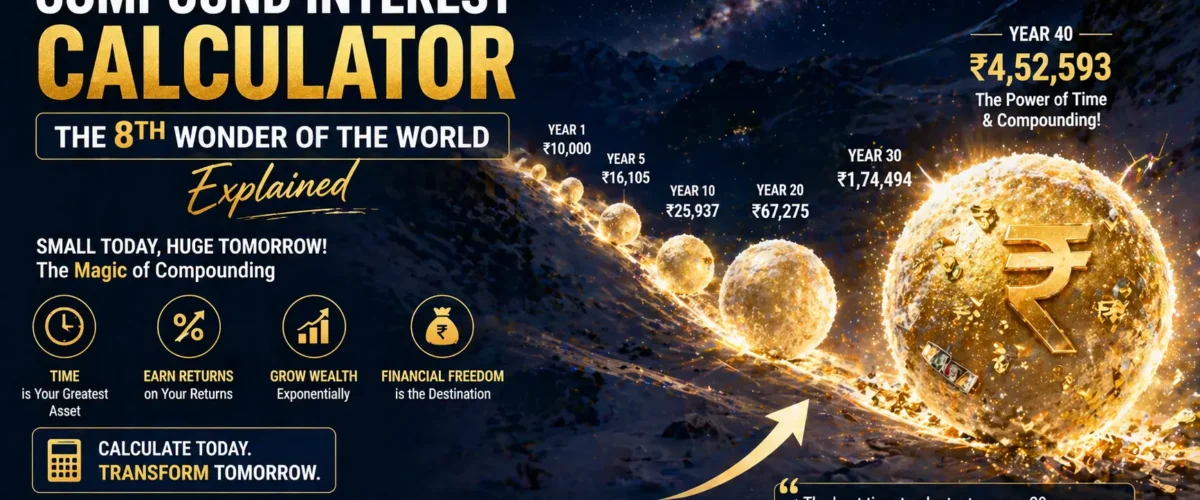
Albert Einstein reportedly called it “the eighth wonder of the world. He who understands it, earns it. He who doesn’t, pays it.”
Those are not merely inspirational words printed on motivational posters. They describe a mathematical force so powerful that it can silently build a fortune over decades — or just as silently destroy one.
Every wealthy investor you admire has compound interest working for them. Every person trapped in a debt spiral has compound interest working against them.
The difference between these two groups is not intelligence, income, or luck. It is understanding — and the single decision to act on that understanding as early as possible.
Here is everything you need to know about compound interest in 2025 — with real numbers that will change how you think about every rupee you save, invest, or borrow.
👉 See compound interest work on your money right now with our free Compound Interest Calculator →
Simple Interest vs Compound Interest: The Critical Difference
Most people learned about interest in school. Very few truly felt the difference between simple and compound interest until they saw what it does to real money over real time.
Simple Interest earns returns only on your original principal — the amount you started with. The return is linear and predictable.
Compound Interest earns returns on your principal AND on every rupee of return you have already earned. The return is exponential and accelerating.
The gap between these two starts small. Then it becomes breathtaking.
| Year | Simple Interest (₹1L at 10%) | Compound Interest (₹1L at 10%) | Compound Advantage |
|---|---|---|---|
| Year 1 | ₹1,10,000 | ₹1,10,000 | Same |
| Year 3 | ₹1,30,000 | ₹1,33,100 | +₹3,100 |
| Year 5 | ₹1,50,000 | ₹1,61,051 | +₹11,051 |
| Year 10 | ₹2,00,000 | ₹2,59,374 | +₹59,374 |
| Year 15 | ₹2,50,000 | ₹4,17,725 | +₹1,67,725 |
| Year 20 | ₹3,00,000 | ₹6,72,750 | +₹3,72,750 |
| Year 30 | ₹4,00,000 | ₹17,44,940 | +₹13,44,940 |
| Year 40 | ₹5,00,000 | ₹45,25,926 | +₹40,25,926 |
After 40 years, compound interest produces ₹45.25 lakhs from ₹1 lakh — while simple interest generates just ₹5 lakhs. That is a 9x difference on the exact same starting amount, at the exact same rate, over the exact same time.
The only variable: whether returns are reinvested or not.
👉 Calculate your exact compound growth with our free Compound Interest Calculator →
The Compound Interest Formula: Explained Simply
The mathematics behind compound interest is straightforward once you see it clearly:
A = P × (1 + r/n)^(n×t)

Where:
A = Final amount (what you end up with)
P = Principal (starting amount)
r = Annual interest rate (as a decimal — so 12% = 0.12)
n = Number of times interest compounds per year
t = Time in years

Example:
₹1,00,000 invested at 12% compounded monthly for 10 years:
A = 1,00,000 × (1 + 0.12/12)^(12×10)
A = 1,00,000 × (1.01)^120
A = 1,00,000 × 3.3004
A = ₹3,30,039
Your ₹1 lakh triples in 10 years at 12% with monthly compounding. No additional investment. No market timing. Just patient, uninterrupted compounding.
👉 Skip the formula — use our Compound Interest Calculator → to get your result in seconds.
The Rule of 72: The Most Useful Mental Shortcut in Finance
The Rule of 72 is a simple shortcut that tells you how many years it takes to double your money at a given interest rate:
Years to Double = 72 ÷ Interest Rate

Examples:
At 6%:  72 ÷ 6 = 12 years to double
At 8%:  72 ÷ 8 = 9 years to double
At 10%: 72 ÷ 10 = 7.2 years to double
At 12%: 72 ÷ 12 = 6 years to double
At 15%: 72 ÷ 15 = 4.8 years to double
At 18%: 72 ÷ 18 = 4 years to double| Interest Rate | Years to Double (Rule of 72) | Years to Double (Actual) | ₹1 Lakh Becomes in 30 Years |
|---|---|---|---|
| 4% (Savings Account) | 18 years | 17.7 years | ₹3,24,340 |
| 6% (RD) | 12 years | 11.9 years | ₹5,74,349 |
| 7% (FD) | 10.3 years | 10.2 years | ₹7,61,226 |
| 10% (Conservative Equity) | 7.2 years | 7.3 years | ₹17,44,940 |
| 12% (Equity SIP avg) | 6 years | 6.1 years | ₹29,95,992 |
| 15% (Strong Equity) | 4.8 years | 5.0 years | ₹66,21,177 |
At 12%, your money doubles every 6 years. In 30 years, it doubles 5 times — turning ₹1 lakh into approximately ₹32 lakhs. At 4% (savings account), it doubles just 1.67 times in 30 years — reaching only ₹3.24 lakhs.
The rate of return is not just important. It is transformational.
Compounding Frequency: How Often Matters
The same annual rate produces different results depending on how frequently interest is calculated and reinvested:
| Compounding Frequency | Effective Annual Rate at 12% Nominal | ₹1 Lakh After 10 Years | ₹1 Lakh After 20 Years |
|---|---|---|---|
| Annual | 12.00% | ₹3,10,585 | ₹9,64,629 |
| Quarterly | 12.55% | ₹3,26,204 | ₹10,64,089 |
| Monthly | 12.68% | ₹3,30,039 | ₹10,89,255 |
| Daily | 12.75% | ₹3,31,946 | ₹11,02,282 |
| Continuous | 12.75% | ₹3,32,012 | ₹11,02,318 |
The difference between annual and daily compounding on ₹1 lakh at 12% over 20 years is ₹37,653 — real money generated simply by more frequent reinvestment of returns.
In practice, most mutual funds and equity investments compound continuously through daily NAV changes — giving you the most powerful compounding frequency without any extra effort.
The Three Variables That Control Your Compounding Outcome
Everything in compound interest ultimately reduces to three variables. Understanding each one changes how you make every financial decision:
Variable 1: Time — The Most Powerful of All Three
No other variable rivals time in its impact on compound growth. Adding 10 years to your investment horizon does not increase your returns by 10 years’ worth — it multiplies them exponentially.
| Starting Age | Monthly SIP | Stop Investing Age | Total Invested | Corpus at Age 60 |
|---|---|---|---|---|
| 20 years old | ₹5,000 | 30 (invest 10 years only!) | ₹6,00,000 | ₹1,89,74,286 |
| 30 years old | ₹5,000 | 60 (invest 30 years!) | ₹18,00,000 | ₹1,76,49,569 |
This is perhaps the most stunning illustration of compounding power: the person who invested for only 10 years starting at age 20 ends up with MORE wealth than the person who invested for 30 years starting at age 30 — despite investing ₹12 lakhs less.
Starting a decade earlier, even if you stop sooner, beats starting later and never stopping. Time is irreplaceable.
👉 Related Reading: How to Become a Millionaire with SIP Calculator → — the full guide to how SIP harnesses the power of compounding.
Variable 2: Rate of Return — The Multiplier
A 1–2% difference in return rate feels insignificant on paper. Over 20–30 years, it produces dramatically different outcomes.
| ₹10,000/month SIP for 25 years | Return Rate | Final Corpus | Difference vs 8% |
|---|---|---|---|
| Conservative | 8% | ₹95,10,224 | Baseline |
| Moderate | 10% | ₹1,32,68,342 | +₹37,58,118 |
| Historical equity avg | 12% | ₹1,89,76,352 | +₹94,66,128 |
| Strong equity | 14% | ₹2,73,84,175 | +₹1,78,73,951 |
A 6% difference in return rate (8% vs 14%) on the same ₹10,000/month over 25 years produces a ₹1.79 crore gap in final wealth. This is why the choice between a savings account (3.5%), FD (7%), and equity SIP (12%) is not a minor decision — it is a life-altering one.
👉 Related Reading: SIP vs FD vs RD — Which Gives More Returns in 2025? → — the complete comparison of return rates across investment vehicles.
Variable 3: Principal — The Fuel
The more you invest, the more compounding has to work with. But note: principal matters less than time and rate. Starting with ₹1,000/month at age 22 is better than starting with ₹10,000/month at age 42 — the 20-year compounding advantage of the smaller amount is more powerful than the 10x principal of the later start.
This does not mean you should not try to increase your investment amount. It means you should never use insufficient funds as an excuse to delay starting.
The Compounding Calendar: What Happens to ₹1,000/Month Over 40 Years
Let us watch ₹1,000/month grow over 40 years at 12% annual returns:
| Decade | Amount Invested (That Decade) | Portfolio Value at End | Growth During Decade |
|---|---|---|---|
| Decade 1 (Years 1–10) | ₹1,20,000 | ₹2,32,339 | ₹1,12,339 |
| Decade 2 (Years 11–20) | ₹1,20,000 | ₹11,64,113 | ₹9,31,774 |
| Decade 3 (Years 21–30) | ₹1,20,000 | ₹38,43,588 | ₹26,79,475 |
| Decade 4 (Years 31–40) | ₹1,20,000 | ₹1,17,64,773 | ₹79,21,185 |
| Total | ₹4,80,000 | ₹1,17,64,773 | ₹1,12,84,773 |
Look at Decade 4: the portfolio grew by ₹79.21 lakhs in just 10 years — on a total investment of only ₹1,000/month. The compounding acceleration in the final years is extraordinary.
This is why the FIRE community, experienced investors, and every serious financial advisor says the same thing: never interrupt compounding. Not for a car. Not for a vacation. Not during a market crash.
Every withdrawal or pause in the compounding journey costs you disproportionately from the accelerating final years.
Compound Interest Working AGAINST You: The Debt Trap
Compound interest is the world’s greatest wealth builder when it works for you. It is the world’s most devastating wealth destroyer when it works against you.
Every high-interest debt — credit card, informal loan, predatory app loan — uses compound interest to silently multiply what you owe.
| Debt | Rate | If You Pay Only Minimum (₹2,000/month) | 5-Year Balance | 10-Year Balance | Total Paid Before Zero Balance |
|---|---|---|---|---|---|
| ₹50,000 credit card | 42% p.a. | Minimum due barely covers interest | ₹2,41,890 | Never clears | ₹10,00,000+ |
| ₹50,000 personal loan | 18% p.a. | EMI of ₹2,500 clears in 2 years | ₹0 | ₹0 | ₹60,000 total |
| ₹50,000 informal loan | 60% p.a. | Minimum barely touches principal | ₹6,50,000 | Never clears | Catastrophic |
Paying only the minimum due on ₹50,000 of credit card debt at 42% p.a. means the balance grows to ₹2.41 lakhs in 5 years despite making monthly payments. The interest compounds faster than your minimum payments reduce the principal.
This is not a hypothetical warning. It is happening right now to millions of people across developing markets — often without them realising it.
👉 Related Reading: Personal Loan vs Credit Card — Which Is Cheaper? → — understand exactly what credit card compounding costs you. 👉 Related Reading: How to Use a Financial Calculator to Escape the Debt Trap → — the step-by-step guide to breaking free from compound interest working against you.
The Two Sides of Compound Interest: A Visual Summary
| Compound Interest Working FOR You | Compound Interest Working AGAINST You |
|---|---|
| SIP in equity mutual funds | Credit card revolving balance |
| PPF at 7.1% compounded annually | Informal lender loan at 60%+ |
| NPS corpus growing tax-deferred | BNPL payments not cleared in time |
| Reinvested dividend stocks | Car loan at high rate over 7 years |
| Starting SIP at age 22 vs 32 | Minimum due trap on any debt |
The rule is brutally simple: get compound interest on your side as early as possible, and eliminate any situation where it is working against you.
How to Make Compound Interest Work for You: 6 Rules
Rule 1 — Start today, not when you have more money. The cost of waiting one year to start investing is not one year’s worth of returns. It is the compounded returns on that year’s investment for the entire remaining horizon. At age 25, waiting one year costs you roughly ₹3–₹5 lakhs in final corpus on a ₹5,000/month SIP.
Rule 2 — Never interrupt the compounding. Pausing a SIP for 6 months costs you those 6 months of investment AND all future compounding on that amount. A single ₹5,000 investment at age 25 grows to approximately ₹2,12,000 by age 65 at 12%. Skipping one month is not saving ₹5,000 — it is giving up ₹2.12 lakhs in future wealth.
Rule 3 — Reinvest every return, dividend, and bonus. Growth options in mutual funds automatically reinvest returns — always choose growth option over dividend payout. Every reinvested rupee becomes part of the compounding base, multiplying all future returns.
Rule 4 — Increase your investment with every income increase. Step-Up SIP — increasing by 10% annually — does not just add linearly to your final corpus. It supercharges the compounding base each year, producing dramatically more wealth than a flat SIP.
Rule 5 — Choose higher-return vehicles for long-term goals. The difference between 7% (FD) and 12% (equity SIP) over 25 years is not 5% more returns. It is 3–4 times more final wealth. For any goal that is 7+ years away, equity SIP is the right compounding vehicle.
Rule 6 — Destroy high-interest debt before growing wealth. It makes no sense to earn 12% on your SIP while paying 40% on your credit card. Every rupee used to clear 40% interest debt earns you a guaranteed, risk-free 40% return. No investment on earth offers that. Clear high-interest debt first — then let compound interest build your wealth.
👉 Related Reading: How Much SIP Per Month to Retire at 45? → — how compounding powers the FIRE movement. 👉 Related Reading: Step-Up SIP Calculator — Grow Wealth 3X Faster → — compounding your compounding with Step-Up SIP.
Compound Interest Across Developing Markets: Universal Power
The mathematics of compound interest is identical in every country and every currency. The opportunity varies only by available investment vehicles and local return rates.
| Country | Best Compounding Vehicle | Historical Long-Term Return | ₹1,000/month equiv. for 25 years |
|---|---|---|---|
| 🇮🇳 India | Equity Mutual Fund SIP | 12–14% CAGR | ₹1,89,76,352 (at 12%) |
| 🇵🇭 Philippines | UITF Equity Funds | 8–12% p.a. | ₱95,10,224–₱1,89,76,352 equiv. |
| 🇳🇬 Nigeria | Nigerian Stock Exchange / Pension Fund | 12–18% p.a. | Varies significantly |
| 🇧🇷 Brazil | Tesouro Direto + Equity Funds | 10–15% p.a. | R$1,32,68,342–₹2,73,84,175 equiv. |
| 🇰🇪 Kenya | NSE Equity / Unit Trusts | 10–15% p.a. | KSh equivalent of above |
Regardless of your country, the compound interest principle is identical: start early, invest consistently, never interrupt, and let time do the extraordinary work.
Frequently Asked Questions
Q: What is the best compounding frequency for investments? A: In practice, most mutual funds and equity investments compound daily or continuously through NAV changes — giving you the most powerful compounding frequency automatically. The difference between monthly and daily compounding is relatively small. Far more important than frequency is the return rate and how long you stay invested.
Q: How does SIP use compound interest? A: Every SIP unit you buy earns returns in the form of NAV appreciation. Those returns become part of your investment base, which then earns further returns. Over 20 years, this creates a compounding snowball where the final 5 years of a 20-year SIP generate more wealth than the first 15 years combined. The mutual fund growth option automatically reinvests all gains — ensuring continuous compounding.
Q: At what age should I start investing to maximise compounding? A: As early as possible — ideally the month you receive your first salary. The data is unambiguous: a 22-year-old investing ₹5,000/month for just 10 years and then stopping ends up with more wealth at 60 than a 32-year-old investing ₹5,000/month every single month for 30 years. Time cannot be bought back.
Q: Can compound interest make me rich if I start late? A: Yes — but you need to compensate with a higher investment amount, a higher savings rate, and a higher return vehicle. Starting at 40 instead of 25 requires approximately 3–4 times the monthly investment to reach the same goal. It is harder, not impossible. Start immediately regardless of age — the best time to plant a tree was 20 years ago; the second best time is today.
Q: How do I use the compound interest calculator effectively? A: Enter your starting investment amount (or monthly SIP), expected annual return rate (use 10–12% for equity SIP, 7% for FD), compounding frequency (monthly for most investments), and time horizon. The calculator shows both your total investment and your final corpus — the difference is the wealth created purely by compounding. Try changing the time horizon by 5 years to see how dramatically starting earlier changes the outcome.
Q: Is compound interest taxed every year? A: For FD and RD — yes. Interest is added to your income and taxed at your slab rate every year, which significantly reduces the effective compounding rate. For equity SIP — no. You pay tax (LTCG at 12.5%) only when you actually sell, and only on gains above ₹1.25 lakh per year. This tax-deferral advantage makes equity SIP’s effective compounding rate significantly higher than FD even at the same nominal return rate.
Conclusion
Albert Einstein’s observation about compound interest is not merely a quote for financial motivational posters. It is a precise description of how the world’s wealth is actually built and destroyed every day.
Every wealthy individual you know — whether they built a business, invested in property, or grew a stock portfolio — has compound interest working powerfully for them through years of patient, uninterrupted growth.
Every person drowning in debt — credit cards, informal loans, predatory apps — has compound interest working against them with equal and merciless power.
The choice of which side you are on is yours. It is made not in one dramatic moment but in thousands of small daily decisions: to invest or to spend, to save or to borrow, to start today or to wait until next month.
The compound interest calculator shows you the mathematical outcome of those decisions — not in vague terms but in exact rupees and paise, 10, 20, and 30 years from now.
Look at that number. Then decide what you want your future to look like.
👉 See the exact power of compounding on your money with our free Compound Interest Calculator → 👉 Related Reading: How to Become a Millionaire with SIP Calculator → 👉 Related Reading: SIP vs FD vs RD — Which Gives More Returns in 2025? → 👉 Related Reading: How Much SIP Per Month to Retire at 45? → 👉 Related Reading: Step-Up SIP Calculator — Grow Wealth 3X Faster → 👉 Related Reading: How to Use an Investment Calculator to Beat Inflation → 👉 Related Reading: Personal Loan vs Credit Card — Which Is Cheaper? → 👉 Related Reading: How to Use a Financial Calculator to Escape the Debt Trap →