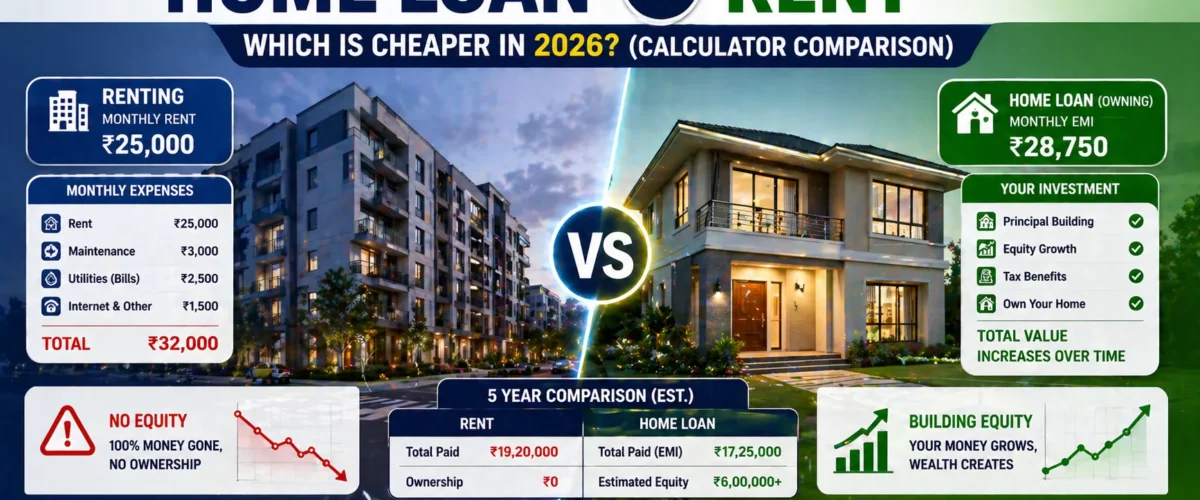
“Rent is throwing money away.”
You have heard this your entire adult life. From parents. From relatives. From colleagues who bought their first home and immediately became evangelists for property ownership.
But here is the uncomfortable truth that those well-meaning advisors rarely acknowledge:
In most major cities across developing markets in 2025, renting is significantly cheaper than buying — when you compare the true, total cost of each option.
And the person who rents, invests the savings, and builds a diversified portfolio can — in many scenarios — end up wealthier than the person who bought the same property.
Does this mean you should never buy a home? Absolutely not. Home ownership has deep financial, emotional, and lifestyle value that cannot be reduced to a spreadsheet.
But the decision deserves honest numbers — not inherited wisdom from a generation that bought homes at 3% interest rates when property prices were a fraction of today’s.
Here is the complete, honest, 2025 cost comparison.
👉 Compare your specific rent vs buy numbers with our free Rent vs Buy Calculator →
The Myth vs The Math
The popular belief: “Every rupee of rent is gone forever. Every rupee of EMI is building equity. Therefore buying is always better.”
The reality is more nuanced — and depends entirely on:
- The rent-to-EMI ratio in your specific city and locality
- How long you plan to stay in the property
- What you do with the savings if renting is cheaper
- Property price appreciation in that specific location
- Transaction and ownership costs that most buyers ignore
Let us examine each factor with real numbers.
The True Cost of Buying a Home: Everything Included
Most people calculate home buying cost as just the EMI. The actual monthly cost of ownership is substantially higher — and this gap is what makes renting more competitive than it appears at first glance.
One-Time Buying Costs (Upfront)
| Cost Component | Typical Amount (₹50L Property) | Notes |
|---|---|---|
| Down Payment (20%) | ₹10,00,000 | Your capital locked into property |
| Stamp Duty | ₹2,50,000–₹4,00,000 | 5–8% in most Indian states |
| Registration Charges | ₹30,000–₹75,000 | 0.6–1.5% of property value |
| Home Loan Processing Fee | ₹15,000–₹50,000 | 0.5–1% of loan amount |
| Legal/Documentation Charges | ₹10,000–₹25,000 | Varies by property type |
| Interior and Renovation | ₹2,00,000–₹10,00,000 | New home always needs work |
| Shifting and Miscellaneous | ₹20,000–₹50,000 | Moving expenses |
| Total Upfront Cost | ₹15,25,000–₹25,00,000 | Beyond the down payment |
On a ₹50 lakh property, your total upfront cash requirement is ₹15–₹25 lakhs — not just the ₹10 lakh down payment. Many buyers who have saved exactly the 20% down payment are shocked to discover they do not have enough cash to actually complete the purchase.
Monthly Ongoing Costs of Ownership
| Monthly Cost Component | Typical Amount | Notes |
|---|---|---|
| Mortgage EMI (₹40L at 8.5%, 20yr) | ₹34,874 | Principal + Interest |
| Property Tax (monthly) | ₹1,500–₹4,000 | 0.1–0.3% of value annually |
| Home Insurance | ₹700–₹1,500 | Property + contents |
| Society/HOA Maintenance | ₹2,000–₹6,000 | Apartment complexes |
| Repairs and Maintenance (1% rule) | ₹2,500–₹4,200 | Budget 1% of value annually |
| Sinking Fund | ₹500–₹1,500 | Future major repairs |
| Opportunity Cost of Down Payment | ₹6,000–₹10,000 | 8% return on ₹10L not invested |
| Total True Monthly Cost | ₹48,074–₹62,074 | vs ₹34,874 EMI alone |
The true monthly cost of owning a ₹50 lakh property is ₹48,000–₹62,000 per month — not the ₹34,874 EMI that buyers typically budget for.
👉 Calculate your true monthly ownership cost with our free Mortgage Calculator →
The True Cost of Renting: Everything Included
Renting is simpler and more transparent — but it has costs beyond just the monthly rent:
| Monthly Cost Component | Typical Amount | Notes |
|---|---|---|
| Monthly Rent (equivalent 2BHK) | ₹15,000–₹25,000 | Varies significantly by city |
| Renter’s Insurance | ₹250–₹500 | Highly recommended, often skipped |
| Broker Fee (amortised over 2 years) | ₹625–₹1,250 | One month rent ÷ 24 months |
| Security Deposit Opportunity Cost | ₹1,500–₹3,000 | Lost return on 2–3 months deposit |
| Moving Costs (amortised over 3 yrs) | ₹500–₹1,000 | Average every 3 years |
| Total True Monthly Cost of Renting | ₹17,875–₹30,750 | |
| Monthly Savings vs Buying | ₹17,324–₹44,199 | This can be invested! |
The renter saves ₹17,000–₹44,000 per month compared to the true cost of owning the equivalent property. That is not money thrown away — it is money available for investment.
The Investment Question: What If the Renter Invests the Savings?
This is the calculation that completely changes the rent vs buy debate — and almost nobody runs it.
If a renter consistently invests the monthly savings (cost of buying minus cost of renting) into an equity SIP, what happens to their wealth over 20 years?
| Scenario | Monthly Saving from Renting | Invested in SIP (12%) | 20-Year Investment Corpus |
|---|---|---|---|
| Conservative (₹20L property, Tier-2 city) | ₹12,000/month | Equity SIP | ₹1,19,89,776 |
| Moderate (₹40L property, Tier-1 city) | ₹22,000/month | Equity SIP | ₹2,19,81,256 |
| High (₹60L property, Metro) | ₹35,000/month | Equity SIP | ₹3,49,70,920 |
A renter in a major metro saving ₹35,000/month (the difference between true ownership cost and rent) and investing it in equity SIP for 20 years builds a corpus of ₹3.49 crore.
The buyer of the same property has built equity in their home — but has also paid enormous amounts in interest, maintenance, and opportunity costs.
Which path builds more total wealth depends critically on property appreciation vs investment returns — which varies dramatically by location.
👉 Related Reading: How to Become a Millionaire with SIP Calculator → — how investing the renting savings builds extraordinary wealth over time.
The Break-Even Analysis: When Does Buying Start to Win?
For buying to be better than renting financially, the property must appreciate enough to overcome:
- All interest paid on the mortgage
- All transaction costs (stamp duty, registration)
- All maintenance and ownership costs
- The opportunity cost of the down payment and monthly payment difference
The break-even point — where buying becomes clearly better than renting — is typically 7–10 years in most Indian cities, assuming moderate property appreciation of 6–8% annually.
| Years in Property | Buy vs Rent Financial Outcome (₹50L property, 8% appreciation, 8.5% loan) | |—|—|—| | 3 years | Renting better by ₹8–₹12 lakhs | | 5 years | Renting better by ₹3–₹6 lakhs | | 7 years | Near break-even — depends on location | | 10 years | Buying better by ₹5–₹15 lakhs | | 15 years | Buying better by ₹20–₹40 lakhs | | 20 years | Buying better by ₹40–₹80 lakhs |
The critical insight: If you plan to stay in the same property for less than 7 years, renting is almost always the better financial decision — the transaction costs and interest loading in early years ensure buying cannot overcome the renting advantage in short timeframes.
City-by-City Rent vs Buy Analysis: India 2025
The rent-to-EMI ratio is the most powerful quick indicator of whether buying or renting makes more financial sense in a specific city:
| City | Avg Rent (2BHK) | Avg Property Price (2BHK) | Avg EMI (80% LTV, 8.5%, 20yr) | Rent-to-EMI Ratio | Quick Verdict |
|---|---|---|---|---|---|
| Mumbai | ₹40,000–₹55,000 | ₹1,20,00,000–₹1,80,00,000 | ₹87,500–₹1,31,250 | 40–50% | Rent strongly — property massively overpriced relative to rent |
| Delhi/NCR | ₹25,000–₹35,000 | ₹70,00,000–₹1,00,00,000 | ₹51,100–₹72,900 | 43–55% | Rent favoured — especially in expensive micro-markets |
| Bangalore | ₹22,000–₹32,000 | ₹60,00,000–₹80,00,000 | ₹43,800–₹58,300 | 47–60% | Borderline — depends on specific location and IT job stability |
| Hyderabad | ₹18,000–₹25,000 | ₹50,00,000–₹65,00,000 | ₹36,500–₹47,400 | 47–60% | Borderline — buy if planning 8+ year stay |
| Pune | ₹18,000–₹24,000 | ₹45,00,000–₹60,00,000 | ₹32,800–₹43,700 | 49–62% | Moderate case for buying with long horizon |
| Chennai | ₹15,000–₹22,000 | ₹40,00,000–₹55,00,000 | ₹29,200–₹40,100 | 48–62% | Buy if 7+ year commitment with strong location |
| Tier-2 Cities | ₹8,000–₹15,000 | ₹20,00,000–₹35,00,000 | ₹14,600–₹25,500 | 49–68% | Better case for buying — more reasonable price-to-rent ratio |
The Rent-to-EMI Ratio Interpretation:
- Below 40%: Renting is dramatically cheaper — only buy with very long-term commitment
- 40–55%: Renting is moderately cheaper — consider buying only if 8+ year commitment
- 55–70%: Near break-even — buying makes sense with 5–7 year plan
- Above 70%: Buying may be better — prices are reasonable relative to rent
Mumbai stands out as the extreme case: the average rent covers only 40–50% of the true ownership cost. A Mumbai renter who invests the difference may genuinely build more wealth than most buyers over 20 years — unless they happened to buy in one of Mumbai’s exceptional appreciation micro-markets.
Rent vs Buy Across Developing Markets: 2025
| Country | City | Monthly Rent (2BHK) | True Monthly Ownership Cost | Rent-to-Ownership Ratio | Verdict |
|---|---|---|---|---|---|
| 🇮🇳 India | Mumbai | ₹45,000 | ₹95,000–₹1,10,000 | 41–47% | Rent strongly |
| 🇮🇳 India | Tier-2 | ₹10,000 | ₹18,000–₹22,000 | 50–60% | Borderline |
| 🇵🇭 Philippines | Manila | ₱15,000 | ₱32,000–₱40,000 | 40–50% | Rent favoured |
| 🇳🇬 Nigeria | Lagos | ₦150,000 | ₦400,000–₦550,000 | 30–40% | Rent strongly |
| 🇧🇷 Brazil | São Paulo | R$3,000 | R$5,500–R$7,000 | 45–55% | Borderline |
| 🇰🇪 Kenya | Nairobi | KSh 30,000 | KSh 55,000–KSh 70,000 | 45–55% | Borderline — buy if stable employment |
Lagos, Nigeria presents the most extreme case: with mortgage rates at 15–22%, the monthly ownership cost of a Lagos property is 2.5–3.5 times the equivalent monthly rent. The case for renting in Lagos — and investing the significant savings — is very strong for most middle-income earners.
10 Situations When Buying Makes Clear Financial Sense
Buy when:
- Your EMI is equal to or less than the equivalent rent in that specific area
- You plan to stay in the same city for 8+ years with high certainty
- You have saved 20%+ down payment without depleting your emergency fund
- Property prices in that location have been growing faster than 8% annually
- You are eligible for government subsidies (PMAY, Pag-IBIG) that significantly reduce effective interest cost
- The home serves as your primary residence — emotional stability and security have genuine value
- Your rental market is highly volatile — frequent rent hikes, unpredictable landlord behaviour
- You have a family with school-age children who need stability and cannot afford to move
- You can negotiate a significantly below-market purchase price
- Mortgage interest and principal qualify for substantial tax deductions (Section 24b + 80C in India)
👉 Related Reading: How to Save Tax Using Home Loan → — the complete guide to home loan tax benefits that improve the buy case.
10 Situations When Renting Makes Clear Financial Sense
Rent when:
- Your monthly rent is less than 50% of the equivalent property’s true ownership cost
- Your career may require relocation within 5 years — job changes, transfers, or career pivots
- You have not yet saved 20% down payment — do not rush into buying with minimum down payment
- Property prices in your target area are at historical highs relative to rents (low rental yield signal)
- You are new to a city — rent for 12–18 months to understand which localities suit your lifestyle before committing
- Your income is variable (commission-based, freelance, business) — fixed mortgage obligations are risky
- You are single or recently married without children — lifestyle flexibility has significant value
- The renting savings invested in equity SIP produce a projected better return than local property appreciation
- You have existing high-interest debt — clearing that debt is a better use of capital than a down payment
- You want to maintain maximum portfolio liquidity for business investment or other opportunities
The Emotional Value of Home Ownership: What the Numbers Cannot Capture
The rent vs buy analysis above is purely financial. But home ownership has real non-financial value that deserves acknowledgment:
Stability and security: No landlord can ask you to vacate. No rent hike surprises. Children stay in the same school, neighbourhood, and friend circle for years.
Freedom to customise: Paint the walls, renovate the kitchen, build the garden you want. A renter’s home is always temporary — an owner’s home is truly theirs.
Forced savings: For many people, the monthly mortgage payment functions as forced equity building — a savings discipline they would not maintain voluntarily through investing.
Inflation protection for housing costs: Your fixed-rate mortgage EMI stays the same in 2035 while your renting neighbours pay 80% more in rent due to inflation.
Retirement security: A paid-off home in retirement eliminates housing costs entirely — providing enormous financial relief when income is fixed.
These factors are real and valuable. For many families, they justify buying even when the pure financial calculation slightly favours renting. The key is making the decision consciously — knowing the financial trade-offs rather than making it based on social pressure or the assumption that buying is always the right choice.
The Rent vs Buy Decision Framework: Your Personal Answer
Use this framework to find YOUR answer — not a generic one:
| Question | If YES → | If NO → |
|---|---|---|
| Is EMI ≤ 60% of true ownership cost? | Buying is more competitive | Renting likely cheaper |
| Will you stay 7+ years? | Buying advantage increases | Renting likely better |
| Do you have 20%+ down payment saved? | Ready to buy | Keep renting and saving |
| Is your income stable and growing? | Buying manageable | Renting safer |
| Is local property appreciating 8%+/year? | Buying likely better | Renting + investing may win |
| Will you invest the renting savings? | Renting may build equal wealth | Buying likely better for forced savings |
| Do you value location flexibility? | Renting provides this | Ownership suits you |
| Is family stability a priority now? | Buying has non-financial value | Renting keeps options open |
If you answered YES to 5 or more questions — the buy case is strong. If you answered NO to 4 or more — renting and investing is likely the better financial path right now.
Frequently Asked Questions
Q: Is 2025 a good time to buy a home in India? A: In most major Indian metros, home prices remain elevated relative to rents — rental yields of 2.5–3.5% indicate property is expensive relative to income it generates. Tier-2 cities and peripheral areas of metros offer better price-to-rent ratios and represent better buying opportunities. The decision depends more on your personal financial readiness than on market timing — a well-priced property in the right location with adequate down payment is worth buying in any year.
Q: What is the break-even point for buying vs renting? A: The break-even point is typically 7–10 years in most Indian cities, assuming 6–8% annual property appreciation and the renter investing the savings at 10–12% returns. In cities with strong property appreciation (Bangalore, Hyderabad tech corridors), the break-even may be 5–7 years. In cities with weak appreciation and high prices (parts of Mumbai), the break-even may extend beyond 15 years.
Q: Is rent really “throwing money away”? A: No — rent is paying for a valuable service: housing, flexibility, zero maintenance responsibility, and freedom from debt. The question is whether rent is a better use of money than the alternative (mortgage interest, property tax, maintenance, and locked-up down payment capital). In many markets, renting and investing the savings builds equal or greater wealth than buying.
Q: Should I buy a home if I have a home loan EMI lower than my current rent? A: If the true all-in ownership cost (EMI + property tax + maintenance + society fees) is equal to or below your current rent for an equivalent property — buying makes strong financial sense. Always compare equivalent properties and full ownership costs, not just the EMI vs rent headline numbers.
Q: How does inflation affect the rent vs buy decision? A: Inflation significantly favours buying over long periods. Your rent increases 5–8% annually in high-inflation developing markets. A fixed-rate mortgage EMI stays constant. After 10 years, your neighbours paying rent may be paying twice what they paid when you took your mortgage — while your EMI is unchanged. This inflation protection is one of the most powerful long-term financial arguments for buying.
Q: Can I buy a home and also invest in SIP simultaneously? A: Yes — and this is the ideal scenario for long-term financial health. After buying, maintain your SIP at minimum 10% of take-home income. The home builds real estate equity and provides residential stability. The SIP builds liquid financial wealth. Together they create a diversified, resilient long-term wealth portfolio that neither strategy alone achieves.
Conclusion
The rent vs buy debate does not have a universal answer — it has your answer, calculated from your specific income, city, down payment, investment discipline, career stability, and family situation.
What this analysis definitively shows is that the blanket statement “renting is throwing money away” is financially incorrect in many of India’s major cities in 2025 — and in most developing market metros with similar price-to-rent dynamics.
The right decision framework is this:
If renting is significantly cheaper AND you will invest the monthly savings consistently → renting may build equal or greater wealth
If the rent-to-EMI ratio is above 60% AND you plan to stay 7+ years AND you have 20% down payment → buying is likely the better financial decision
Run your specific numbers. Make the decision consciously. And whatever you choose — commit fully to the investment discipline that makes it succeed.
👉 Compare your exact rent vs buy numbers with our free Rent vs Buy Calculator → 👉 Related Reading: Mortgage Calculator — How Much Home Can You Afford? → 👉 Related Reading: Down Payment Calculator — How to Buy a House Faster → 👉 Related Reading: How Banks Calculate Your Home Loan Eligibility → 👉 Related Reading: Fixed vs Floating Rate Mortgage — 10-Year Cost Comparison → 👉 Related Reading: How to Save Tax Using Home Loan → 👉 Related Reading: Real Estate ROI Calculator — Is Property a Good Investment? → 👉 Related Reading: How to Become a Millionaire with SIP Calculator →