Every business owner in India knows GST exists.
But how many truly understand how GST is silently eating into their profits every month — or conversely, how the Input Tax Credit mechanism can put thousands of rupees back into their business every quarter?
Most small business owners treat GST as a pass-through nuisance — collect it, pay it, file it, forget it. The ones who understand it deeply treat it as a cash flow and profitability tool — one that, when managed correctly, can meaningfully reduce their effective tax burden and improve working capital.
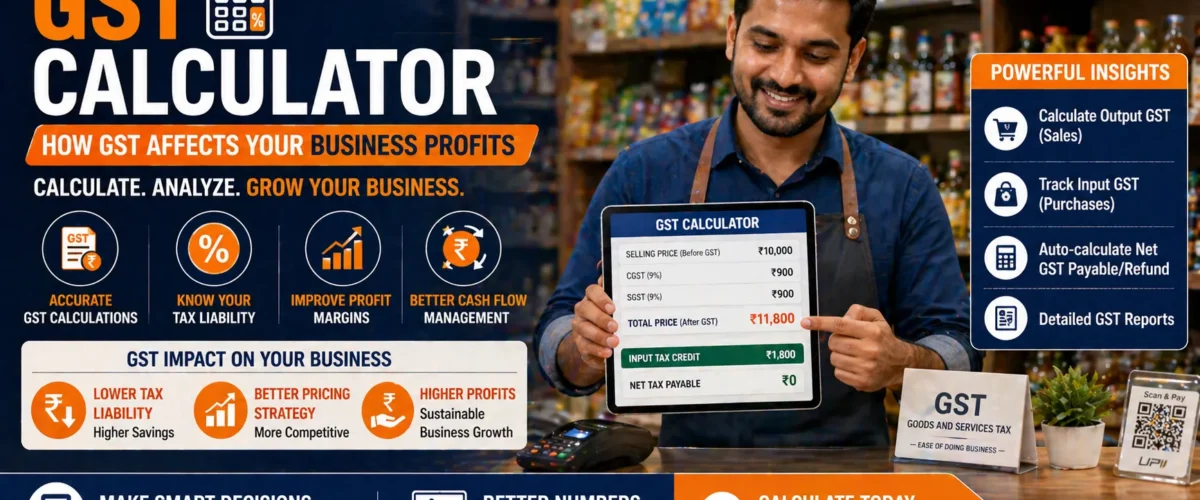
Here is the complete 2026 guide to understanding, calculating, and optimising GST for your business — with our free calculator to make every transaction crystal clear in seconds.
👉 Calculate GST on any transaction instantly with our free GST Calculator →
How GST Actually Works: The Mechanism Most Business Owners Misunderstand
GST (Goods and Services Tax) is a destination-based, multi-stage consumption tax. It is collected at every stage of the supply chain — but each business only pays the net difference between GST collected from customers and GST paid to suppliers.
This net difference mechanism is called the Input Tax Credit (ITC) system — and it is the fundamental reason why GST, when properly managed, should be largely neutral for most B2B businesses.
Core GST Formula:

GST Payable to Government = Output GST − Input GST (ITC)

Where:
Output GST = GST you collect from your customers on sales
Input GST (ITC) = GST you pay to your suppliers on purchases

Example:
You sell goods for ₹1,00,000 + 18% GST = ₹1,18,000 collected
You purchase materials for ₹60,000 + 18% GST = ₹70,800 paid

Output GST Collected: ₹18,000
ITC (Input GST Paid): ₹10,800
Net GST Payable: ₹18,000 − ₹10,800 = ₹7,200
You are effectively the government’s tax collection agent — collecting GST from customers, recovering GST paid to suppliers, and remitting only the difference. Your business itself should bear zero GST cost — unless you are the final consumer, or if ITC is blocked on certain purchases.
GST Rate Structure 2026: Complete Reference
Understanding which rate applies to your products and services is the foundation of correct GST calculation:
| GST Slab | Rate | Examples of Goods/Services |
|---|---|---|
| Exempt | 0% | Fresh fruits and vegetables, milk, eggs, curd, bread, unprocessed cereals, healthcare services, education services, public transport |
| Essential | 5% | Packaged food items, tea, coffee, edible oils, small restaurants (no ITC), economy class air travel, life-saving medicines |
| Standard — Low | 12% | Processed foods, butter, ghee, mobile phones, computers, business class air travel, hotels (₹1,000–₹7,500/night) |
| Standard — High | 18% | Most goods and services, consumer electronics, construction services, banking and financial services, IT services, hotels (above ₹7,500/night) |
| Luxury/Sin Goods | 28% | Cars (above 1200cc), tobacco products, aerated drinks, cement, luxury hotels, casinos |
| Plus Cess on 28% | 28% + Cess | Automobiles: additional cess 1–22% depending on type; tobacco: 5–290% cess |
Finding your GST rate: Every good and service is classified under the Harmonised System of Nomenclature (HSN code for goods) or Service Accounting Code (SAC for services). Your GST rate is determined by your product’s HSN/SAC code — not by your general industry category. When in doubt, consult the official GST rate schedule or a CA.
The GST Calculator: How to Use It for Every Transaction
Our GST Calculator handles three essential business calculations:
Calculation 1: Adding GST to Your Price (Tax-Exclusive)
When you know the base price and need to find the GST amount and final price:
GST Amount = Base Price × (GST Rate ÷ 100)
Final Price = Base Price + GST Amount

Example (18% GST):
Base Price: ₹50,000
GST Amount: ₹50,000 × 18% = ₹9,000
Final Invoice Price: ₹59,000
Calculation 2: Extracting GST from a Price (Tax-Inclusive)
When you have an MRP or final price and need to find the embedded GST:
GST Amount = Final Price × GST Rate ÷ (100 + GST Rate)
Base Price = Final Price − GST Amount

Example (18% GST in ₹59,000 price):
GST Amount: ₹59,000 × 18 ÷ 118 = ₹9,000
Base Price: ₹59,000 − ₹9,000 = ₹50,000
Calculation 3: CGST and SGST Split (Intra-State Transactions)
For sales within the same state — GST is split equally between Central GST (CGST) and State GST (SGST):
For 18% GST on intra-state transaction:
CGST = 9% (half of 18%)
SGST = 9% (half of 18%)

For 12% GST:
CGST = 6%, SGST = 6%

For inter-state transactions:
Integrated GST (IGST) = Full rate (18%, 12%, etc.) — no split| Transaction Type | GST Type | Split |
|---|---|---|
| Intra-state (within same state) | CGST + SGST | Equal halves |
| Inter-state (between different states) | IGST | Full rate, single levy |
| Import of goods | IGST + Customs Duty | Full rate |
| Export of goods | Zero-rated (0%) | Refund of ITC available |
👉 Calculate CGST, SGST, and IGST for any transaction with our free GST Calculator →
How GST Affects Business Profit: Four Business Types Compared
The impact of GST on actual profitability varies dramatically based on business type, ITC eligibility, and whether customers are GST-registered:
Type 1: B2B Business (Manufacturer to Wholesaler) — GST Neutral
| Item | Amount | Notes |
|---|---|---|
| Sales Revenue | ₹5,00,000 | Net of GST |
| GST Collected (18%) | ₹90,000 | Liability |
| Purchase Cost | ₹3,00,000 | Net of GST |
| ITC on Purchases (18%) | ₹54,000 | Credit |
| Net GST Payable | ₹36,000 | ₹90,000 − ₹54,000 |
| Gross Profit | ₹2,00,000 | ₹5L − ₹3L |
| GST Impact on Profit | ₹0 | Fully offset by ITC |
For a pure B2B business with full ITC, GST has zero impact on profitability. It is entirely a government collection mechanism flowing through the business.
Type 2: B2C Restaurant (5% GST, No ITC) — GST Hits Margins
| Item | Amount | Notes |
|---|---|---|
| Sales Revenue (GST inclusive) | ₹1,00,000 | What customer pays |
| GST Collected (5%) | ₹4,762 | Embedded in price |
| Food/Material Cost (incl. 5–12% GST) | ₹35,000 | Cannot claim ITC |
| ITC on Purchases | ₹0 | Blocked for restaurants at 5% |
| Net GST Payable | ₹4,762 | Full output GST |
| Effective Margin Impact | −4.8% | On revenue |
Restaurants opting for 5% GST rate cannot claim input tax credit on their purchases — meaning the GST they pay to suppliers is a genuine cost that reduces their profit margin. A restaurant spending ₹35,000 on ingredients (with ₹1,750–₹3,500 in embedded GST) loses all of that to unrecoverable ITC.
The alternative: restaurants can opt for 18% GST with full ITC — sometimes better for high-volume restaurants with significant input purchases. Always calculate which option is better for your specific cost structure.
Type 3: IT Services Company — GST Neutral for Registered Clients, Cost for Unregistered
| Item | B2B Client (Registered) | B2C Individual Client |
|---|---|---|
| Service Fee | ₹1,00,000 | ₹1,00,000 |
| GST Charged (18%) | ₹18,000 | ₹18,000 |
| Client Outcome | Claims ₹18,000 as ITC | Pays ₹18,000 — pure cost |
| Your GST on Expenses | ₹9,000 | ₹9,000 |
| Net GST Payable | ₹9,000 | ₹9,000 |
| Effective GST Cost to You | ₹0 | ₹0 |
| Effective GST Cost to Client | ₹0 (ITC recovered) | ₹18,000 (no recovery) |
For B2B IT services — GST is genuinely neutral: your client recovers it as ITC. For individual (B2C) IT services — the 18% GST is a genuine 18% price increase that reduces your competitive position versus unregistered competitors charging below-threshold.
Type 4: Small Retailer Below ₹40L Threshold — Voluntary Registration Decision
| Scenario | Unregistered (Below ₹40L) | Voluntarily Registered |
|---|---|---|
| Can charge GST on sales? | No | Yes |
| Can claim ITC on purchases? | No | Yes |
| B2B customers prefer you? | No (cannot give them ITC) | Yes (they can claim ITC) |
| Compliance burden | Zero | Monthly/quarterly filing |
| Net GST cost on purchases | Real cost (no ITC) | Recovered via ITC |
| Best choice if: | Mostly B2C consumers | Mostly B2B business customers |
The Input Tax Credit Goldmine: What Most Small Businesses Miss
ITC is the most underutilised feature of GST — and the most financially valuable. Here is a systematic guide to every ITC claim you are entitled to:
ITC You Can Claim
| Purchase Category | ITC Available? | Notes |
|---|---|---|
| Raw materials and inputs | ✅ Full ITC | Core business input |
| Capital goods (machinery, equipment) | ✅ Full ITC | Spread over time if > ₹1 lakh in some cases |
| Business services (legal, accounting, IT) | ✅ Full ITC | Must receive tax invoice |
| Office supplies and stationery | ✅ Full ITC | For business use |
| Business travel (air, rail, hotel) | ✅ Full ITC | Hotel ITC — check if business purpose |
| Mobile phones for business | ✅ Full ITC | Pro-rate if personal use too |
| Business insurance | ✅ Full ITC | Includes fire, stock, machinery insurance |
| Advertising and marketing | ✅ Full ITC | Digital ads, print, outdoor |
ITC You CANNOT Claim (Blocked Credits)
| Purchase Category | ITC Blocked? | Why |
|---|---|---|
| Motor vehicles (below 13 seaters) | ❌ Blocked | Unless used for transport of passengers, goods, or driving training |
| Food and beverages | ❌ Blocked | Unless you are in food/catering business |
| Health club and gym memberships | ❌ Blocked | Personal benefit |
| Club membership fees | ❌ Blocked | Personal benefit |
| Construction of immovable property | ❌ Blocked | Except plant and machinery |
| Personal use items | ❌ Blocked | Not for business |
| Purchases from unregistered suppliers | ❌ Blocked | No GST invoice |
The ITC optimisation strategy: Ensure every business purchase comes with a proper GST invoice — from a registered supplier — with your GSTIN on the invoice. Purchases without valid invoices cannot be claimed as ITC. This single discipline — always asking for GST invoice from registered suppliers — can recover ₹20,000–₹2,00,000 in annual ITC for many small businesses.
GST and Cash Flow: The Working Capital Impact Nobody Talks About
GST creates a timing mismatch between when you collect GST from customers and when you deposit it to the government. Managing this mismatch is critical for cash flow:
The typical cycle:
Month 1: You make sales and collect ₹18,000 GST from customers
Month 1: You make purchases and pay ₹10,800 GST to suppliers
Month 1 (20th): You deposit ₹7,200 net GST via GSTR-3B filing
For businesses with:
- Short payment cycles (customers pay immediately): Cash flow is smooth
- Long payment cycles (B2B with 60-90 day credit terms): You must deposit GST before collecting it from customers — creating a working capital crunch
Example of the GST working capital problem:
Invoice raised on January 1: ₹5,00,000 + ₹90,000 GST
Customer payment terms: Net 60 days (March 1)
GSTR-3B filing deadline: January 20
GST deposit required: ₹36,000 (Jan 20)
Customer payment received: March 1

Working capital gap: ₹36,000 tied up from January 20 to March 1
= 39 days of ₹36,000 at no return
For large businesses with crores of turnover and long credit cycles, this GST working capital impact can be significant — requiring dedicated credit facilities or working capital loans to manage.
Solution strategies:
- Match payment terms with GST filing cycles where possible
- Maintain a dedicated GST liability reserve account
- Use the ITC balance to offset output liability before using cash
- For exporters: claim ITC refunds promptly — GST refunds on exports must be applied for and can take 30–60 days
GST Registration: When Is It Mandatory? When Is It Voluntary?
Mandatory Registration Thresholds (2026)
| Business Type | State Category | Threshold |
|---|---|---|
| Goods suppliers | Normal states | ₹40 lakhs annual turnover |
| Goods suppliers | Special category (NE states, Uttarakhand, Himachal) | ₹20 lakhs |
| Service providers | All states | ₹20 lakhs |
| E-commerce sellers | All states | Mandatory regardless of turnover |
| Inter-state suppliers | All | Mandatory regardless of turnover |
| Casual taxable persons | All | Mandatory regardless of turnover |
| Reverse charge mechanism applicable | All | Case-specific |
Special Note for 2026: The government has been reviewing these thresholds — always verify current limits on the official GST portal (gst.gov.in) as they may have been revised.
When Voluntary Registration Makes Sense
Even below the mandatory threshold, voluntary GST registration is financially beneficial when:
You sell primarily to GST-registered businesses: Large B2B buyers strongly prefer purchasing from GST-registered suppliers — because they can claim ITC on their purchases. An unregistered supplier cannot provide a GST invoice, making you uncompetitive for any business customer above the threshold. Voluntary registration makes you competitive for the entire B2B market.
Your input costs carry significant GST: If you purchase materials at 12–18% GST and sell without GST (because you are unregistered), you lose all ITC on inputs. Registration allows you to claim this back.
You want to scale: Registering before you hit the threshold allows you to build GST compliance systems, get comfortable with filing, and have GST credentials ready for larger clients who will not buy from an unregistered vendor.
GST Composition Scheme: The Small Business Simplifier
For small businesses below ₹1.5 crore turnover (₹75 lakhs for service providers), the Composition Scheme offers dramatically simplified compliance in exchange for a flat tax rate:
| Business Type | Composition Tax Rate | Normal GST Rate | Applicable Turnover Limit |
|---|---|---|---|
| Manufacturers | 1% of turnover | 5–28% | Up to ₹1.5 crore |
| Traders | 1% of turnover | 5–28% | Up to ₹1.5 crore |
| Restaurants | 5% of turnover | 5% (no ITC) | Up to ₹1.5 crore |
| Service providers | 6% of turnover | 18% | Up to ₹75 lakhs |
Advantages of Composition Scheme:
- Quarterly filing (vs monthly for regular taxpayers)
- No tax invoice required — only bill of supply
- No complex ITC calculations
- Lower compliance cost
Disadvantages of Composition Scheme:
- Cannot collect GST from customers (you absorb the tax)
- Cannot claim ITC on purchases
- Cannot make inter-state sales
- B2B customers cannot claim ITC from you
When Composition makes sense: Primarily B2C businesses (retail shops, local restaurants) with simple operations, mostly local sales, and where customers are individuals who do not need ITC.
When Composition does NOT make sense: Any business with significant B2B sales, inter-state operations, or high input costs where ITC would be valuable.
GST Returns: What You Must File and When
GST compliance involves multiple return filings throughout the year:
| Return | What It Contains | Due Date | Who Files |
|---|---|---|---|
| GSTR-1 | Details of outward supplies (sales invoices) | 11th of following month (monthly) / 13th of quarter end (quarterly) | All registered taxpayers |
| GSTR-3B | Summary return + net GST payment | 20th of following month | All registered taxpayers |
| GSTR-2B | Auto-populated ITC statement | 14th of following month | Reference only — no filing |
| GSTR-9 | Annual return | December 31 (for previous FY) | Turnover above ₹2 crore |
| GSTR-9C | Reconciliation statement | December 31 | Turnover above ₹5 crore |
| GSTR-4 | Composition taxpayer annual return | April 30 | Composition scheme taxpayers |
The QRMP Scheme (Quarterly Return Monthly Payment): For taxpayers with turnover below ₹5 crore — GSTR-1 and GSTR-3B can be filed quarterly (not monthly), but tax must still be paid monthly. This reduces filing burden while maintaining regular payment compliance.
Late filing penalties:
- GSTR-3B: ₹50/day (₹25 CGST + ₹25 SGST) for tax payable; ₹20/day (₹10 CGST + ₹10 SGST) for nil returns
- Maximum late fee: ₹10,000 per return
- Interest on late payment: 18% per annum on outstanding tax
Industry-Specific GST Impact: 2026 Analysis
Manufacturing Business
For a manufacturer, GST provides significant ITC benefits — raw materials, machinery, and business services all carry recoverable input tax:
| Item | Annual Value | GST Rate | GST Paid | ITC Recovered? |
|---|---|---|---|---|
| Raw materials | ₹40,00,000 | 12% | ₹4,80,000 | ✅ Yes |
| Machinery maintenance | ₹5,00,000 | 18% | ₹90,000 | ✅ Yes |
| Business services | ₹3,00,000 | 18% | ₹54,000 | ✅ Yes |
| Vehicles (cars) | ₹20,00,000 | 28% | ₹5,60,000 | ❌ No (blocked) |
| Total ITC Recoverable | ₹6,24,000/year |
A manufacturer recovering ₹6.24 lakhs in annual ITC — that is cash back into the business every quarter from purchases you were going to make anyway.
E-Commerce Seller
E-commerce sellers face mandatory registration regardless of turnover — and have additional complexity from Tax Collection at Source (TCS):
| GST Compliance Item | Requirement |
|---|---|
| Registration | Mandatory — no threshold exemption |
| TCS deduction by platform | 1% TCS collected by Amazon/Flipkart/Meesho on net sales value |
| GSTR-8 filed by platforms | Monthly — showing TCS collected from your account |
| Your ITC from TCS | Reflected in GSTR-2B — claim against your output liability |
| Effective cash flow impact | 1% of sales temporarily held by platform — recovered monthly |
For an e-commerce seller doing ₹15 lakhs/month in sales — ₹15,000/month is held as TCS by the platform. This ₹15,000 is not lost — it is credit available in GSTR-2B — but it creates a temporary working capital impact until reconciled.
Service Business (Consulting/Freelance)
For a consultant or freelancer crossing the ₹20 lakh threshold:
Annual Consulting Revenue: ₹25,00,000
GST on Revenue (18%): ₹4,50,000

Eligible ITC (office expenses, software, professional services):
Office rent: Not applicable (GST not applicable on most residential)
Software subscriptions: ₹50,000 + ₹9,000 GST
Professional services: ₹1,00,000 + ₹18,000 GST
Internet and phone: ₹30,000 + ₹5,400 GST
Total ITC: ₹32,400

Net GST Payable: ₹4,50,000 − ₹32,400 = ₹4,17,600
For consultants with primarily B2B clients — the 18% GST does not affect competitiveness (clients recover ITC). For B2C consultants — the 18% is a genuine price barrier against unregistered sub-threshold competitors.
GST and Your Business Pricing Strategy
GST registration significantly affects how you price your products and services — particularly in competitive markets where some competitors are registered and others are not:
Scenario: You Are GST Registered, Competitor Is Not
| Item | Your Price | Unregistered Competitor |
|---|---|---|
| Base price | ₹10,000 | ₹10,000 |
| GST (18%) | ₹1,800 | ₹0 |
| Total price charged | ₹11,800 | ₹10,000 |
| Customer (B2C) pays | ₹11,800 | ₹10,000 |
| Customer (B2B registered) pays | ₹11,800 | ₹10,000 |
| Customer (B2B) effective cost after ITC | ₹10,000 | ₹10,000 |
The critical insight: For B2B customers, your higher invoice price (₹11,800) is exactly equal in effective cost to the competitor’s ₹10,000 — because your customer claims ₹1,800 as ITC. Your GST registration is not a pricing disadvantage for B2B customers — it is an advantage, because they prefer vendors who provide GST invoices.
For B2C customers however — your ₹11,800 vs competitor’s ₹10,000 is a real 18% price difference. Strategies for B2C businesses to manage this: absorb the GST into your pricing (reduce base price by ₹1,525 to maintain same final price), pass it on (at the risk of price comparison), or segment your pricing differently for B2B vs B2C.
The GST Audit: What Triggers It and How to Stay Safe
GST authorities use data analytics to identify discrepancies between:
- GSTR-1 (sales declared) vs actual sales
- GSTR-3B (ITC claimed) vs GSTR-2B (ITC available based on supplier filings)
- GST returns vs income tax returns (turnover declared)
- GST returns vs bank statements
High audit trigger situations:
- Large ITC claims relative to output tax (low net GST liability)
- Significant differences between GSTR-1 and GSTR-3B turnover
- Suppliers who have not filed their GSTR-1 (your ITC appears in their data)
- Turnover in GST returns significantly different from ITR/bank statements
- Claiming ITC on blocked categories (cars, food, personal items)
- Frequent nil returns followed by sudden large filings
How to stay audit-safe:
- Always reconcile GSTR-2B before claiming ITC — only claim what appears in GSTR-2B
- Maintain proper tax invoices for every purchase claimed as ITC
- Ensure turnover consistency across GST returns and income tax returns
- File all returns on time — late filers are flagged for review
- Keep purchase and sales ledgers that match your GST return figures exactly
GST for Businesses Across Developing Markets: A Quick Comparison
| Country | Tax System | Standard Rate | ITC Available? | Registration Threshold |
|---|---|---|---|---|
| 🇮🇳 India | GST (unified) | 18% (standard) | Yes — full ITC | ₹40L (goods), ₹20L (services) |
| 🇧🇷 Brazil | ICMS + ISS + IPI | 17–19% (ICMS) + others | Partial — complex | State-specific |
| 🇳🇬 Nigeria | VAT | 7.5% | Yes — limited | ₦25M (~₹11.25L) annual |
| 🇵🇭 Philippines | VAT | 12% | Yes — full ITC | ₱3M (~₹45L) annual |
| 🇰🇪 Kenya | VAT | 16% | Yes — standard ITC | KSh 5M (~₹30L) annual |
| 🇿🇦 South Africa | VAT | 15% | Yes — full ITC | R1M (~₹44L) annual |
| 🇸🇬 Singapore | GST | 9% | Yes — input tax credit | S$1M (~₹61L) annual |
Brazil’s complexity warning: Brazil does not have a unified consumption tax — businesses deal with ICMS (state-level goods tax), ISS (municipal services tax), and IPI (federal excise) simultaneously. A Brazilian business can face 3–5 different tax calculations on a single transaction. The Brazilian government has been working on tax reform (PEC 45/2019) to unify these — implementation is ongoing as of 2026.
Nigeria’s lower rate advantage: At 7.5% VAT, Nigeria has one of the lowest consumption tax rates in Africa — making it relatively competitive for business cost structures compared to Kenya (16%) or South Africa (15%).
Frequently Asked Questions
Q: Should I register for GST voluntarily if my turnover is below the threshold? A: Yes — if the majority of your customers are GST-registered businesses. Voluntary registration allows you to issue GST invoices (helping your B2B customers claim ITC), claim ITC on your own purchases, and appear more professional and scalable. The compliance burden (monthly/quarterly returns) is the trade-off. If you serve primarily individual consumers who cannot claim ITC, the urgency is lower — but registration before you approach ₹30–₹35 lakh turnover allows smooth transition without disruption.
Q: What is the GST Composition Scheme and should I opt for it? A: The Composition Scheme allows businesses below ₹1.5 crore (₹75 lakhs for services) to pay a flat 1–6% tax on turnover with minimal compliance. It is ideal for small B2C businesses like local retailers and restaurants. However, you cannot issue GST invoices, cannot claim ITC, and cannot serve B2B customers effectively. If you have or plan to have any significant B2B clientele — stay on the regular scheme.
Q: How do I claim ITC on my business purchases? A: Ensure every purchase has a valid GST tax invoice with your GSTIN. Your supplier must also file their GSTR-1, which auto-populates your GSTR-2B. Claim only the ITC appearing in GSTR-2B — claiming ITC not in GSTR-2B (due to supplier non-compliance) is now a compliance risk. If a supplier’s GSTR-1 shows discrepancies, follow up with them to rectify before claiming.
Q: My supplier is not filing GST returns — can I still claim ITC? A: From FY 2022–23, ITC can only be claimed up to the amount appearing in GSTR-2B. If your supplier does not file GSTR-1, their invoices do not appear in your GSTR-2B — and you cannot claim the ITC. This is a serious issue — it means your supplier’s non-compliance directly harms your cash flow. Pressure non-compliant suppliers to file, or switch to compliant alternatives. This is one of the most important supplier selection criteria for any GST-registered business.
Q: What is the penalty for not registering under GST when mandatory? A: Non-registration when mandatory results in a penalty equal to 100% of the tax due (minimum ₹10,000). All unregistered sales become subject to GST from the threshold-crossing date. Interest at 18% per annum applies on the overdue tax. Additionally, customers who paid you without GST cannot claim ITC retrospectively — potentially damaging business relationships. Always register on time.
Q: Can I claim ITC on a car purchased for business use? A: Generally no — motor vehicles (cars and motorcycles) are blocked credits under GST, with specific exceptions. Exceptions where ITC IS available: vehicles used for transportation of goods (trucks, delivery vans), vehicles used for passenger transport services (taxis, buses), and vehicles used for driver training. A car purchased for general business use by directors or employees does not qualify for ITC — even if exclusively used for business travel.
Conclusion
GST, properly understood, is far less complex and far more business-friendly than most small business owners believe. The Input Tax Credit mechanism ensures that well-managed businesses bear little to no net GST cost on their B2B operations — it simply flows through the business to the final consumer.
The businesses that struggle with GST are those that:
- Treat it as a compliance burden rather than a cash flow tool
- Miss ITC claims by not collecting proper invoices
- File returns late and accumulate penalties unnecessarily
- Operate with suppliers who do not file returns — losing ITC
The businesses that benefit from GST management are those that:
- Claim every eligible rupee of ITC quarterly
- Maintain clean invoice records matched to GSTR-2B
- Choose Composition vs Regular scheme based on actual business economics
- Register voluntarily to serve B2B customers who need ITC invoices
- Price correctly — knowing that B2B clients see zero net price difference due to ITC
Use our GST Calculator to make every transaction transparent — and treat GST management as the working capital and profitability tool it truly is.
👉 Calculate GST for any transaction instantly with our free GST Calculator → 👉 Related Reading: Income Tax Calculator 2026 — Save Maximum Tax Legally → 👉 Related Reading: GST vs VAT — Which Countries Pay More Tax? → 👉 Related Reading: Capital Gains Tax Calculator — Stocks, Property & Crypto → 👉 Related Reading: Tax-Saving Investment Calculator — 5 Best Options for 2026 → 👉 Related Reading: Salary After Tax Calculator — What’s Your Real Take-Home? → 👉 Related Reading: How to Save Tax Using Home Loan — Complete Guide →