


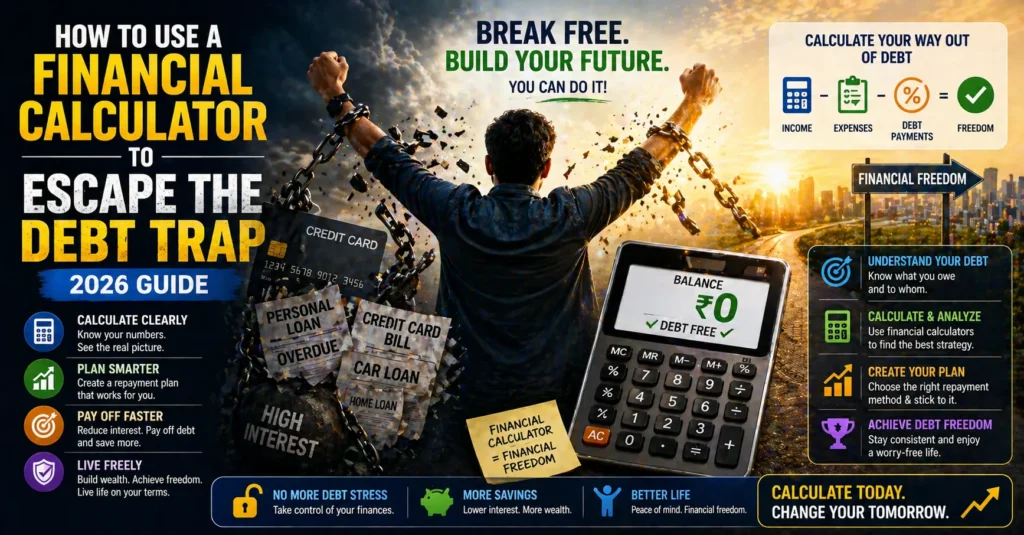
You know the feeling.
The salary arrives. Within days — sometimes hours — it is gone. Not to savings. Not to investments. To EMIs. To minimum credit card dues. To the app loan you took to cover last month’s shortfall. To the family obligation that arrived unexpectedly.
And next month, the same cycle begins again. Maybe slightly worse than before.
This is the debt trap — and it has captured hundreds of millions of people across India, Philippines, Nigeria, Brazil, Kenya, and Pakistan. Not because they are irresponsible. Not because they do not work hard enough. But because nobody showed them the mathematical exit that exists for every debt situation — no matter how overwhelming it feels right now.
The financial calculator is that exit door.
It shows you — in exact numbers, with exact timelines — how to systematically eliminate every debt, in what order, and exactly when you will be free.
Here is everything you need to know.
👉 Map your debts and find your freedom date with our free Debt Payoff Calculator →
Are You in a Debt Trap? The 5 Warning Signs
Before the solution, honest diagnosis. Check how many of these apply to your situation:
| Warning Sign | Description | Your Score |
|---|---|---|
| Sign 1 | Total monthly EMIs exceed 50% of take-home salary | ☐ Yes / ☐ No |
| Sign 2 | You have borrowed new money to repay existing debt | ☐ Yes / ☐ No |
| Sign 3 | You pay only the minimum due on credit cards every month | ☐ Yes / ☐ No |
| Sign 4 | Your total outstanding debt is growing despite regular payments | ☐ Yes / ☐ No |
| Sign 5 | You have borrowed from informal sources — moneylenders, app loans, colleagues | ☐ Yes / ☐ No |
Score interpretation:
- 1–2 signs: Warning stage — take action now before it worsens
- 3–4 signs: Debt trap confirmed — structured intervention needed immediately
- 5 signs: Crisis stage — emergency action required today
If you scored even 1 — this guide is for you. Do not wait for 5.
Step 1: The Debt Map — Know Exactly What You Owe
The most important — and most avoided — step in escaping debt is creating a complete, honest inventory of every single debt. Most people in a debt trap have a vague, anxious sense of their total debt but avoid knowing the precise number.
The calculator cannot help you if you do not give it accurate inputs.
Create your complete debt map:
| Debt | Outstanding Balance | Interest Rate | Monthly EMI/Min Payment | Payoff Date (Current) | Monthly Interest Cost |
|---|---|---|---|---|---|
| Credit Card 1 | ₹75,000 | 42% p.a. | ₹2,000 (min due) | Never clears | ₹2,625/month |
| Credit Card 2 | ₹40,000 | 36% p.a. | ₹1,200 (min due) | Never clears | ₹1,200/month |
| Personal Loan | ₹1,50,000 | 18% p.a. | ₹4,500/month | 40 months | ₹2,250/month |
| App/Digital Loan | ₹30,000 | 60% p.a. | ₹3,500/month | 10 months | ₹1,500/month |
| Car Loan | ₹3,50,000 | 10% p.a. | ₹8,500/month | 48 months | ₹2,917/month |
| Family Loan | ₹50,000 | 0% (no interest) | ₹2,000/month | 25 months | ₹0 |
| TOTAL | ₹6,95,000 | ₹21,700/month | ₹10,492/month in interest |
This example profile is paying ₹10,492 every single month purely in interest — money that is completely gone, building zero equity, funding nothing but the lender’s profit.
Over 12 months: ₹1,25,904 in interest alone. That is ₹1.26 lakhs spent on nothing — every year — just to stay in place.
👉 Enter your complete debt profile into our free Debt Payoff Calculator → to see your total interest burden and payoff timeline.
Step 2: Stop the Bleeding — The Non-Negotiable First Actions
Before any debt payoff strategy — you must stop the debt from growing. A bucket with holes cannot be filled no matter how fast you pour water in.
Action 1 — Stop all new high-interest borrowing immediately. No new credit card spending beyond what you can pay in full. No new app loans. No new informal borrowing. Every new debt adds to the problem — even if it feels like it solves a short-term crisis.
Action 2 — Cancel or freeze credit cards that you cannot pay in full. Physical discipline: put the cards in a drawer. Cancel the stored card numbers on shopping apps. Remove the Apple Pay / Google Pay connection. Make spending on credit cards requires conscious friction.
Action 3 — Identify one expense to cut immediately. Find ₹2,000–₹5,000 of monthly spending that can be eliminated without genuine hardship. This becomes your extra debt payment from Month 1. Streaming subscriptions, dining out, gym memberships, upgrade services — something must go.
Action 4 — Never pay only the minimum due on a credit card. The minimum due on a credit card is specifically calculated to keep you in debt as long as possible while maximising the bank’s interest income. It is not a payment — it is a trap designed to look like a payment.
Example: ₹75,000 credit card at 42% p.a.
Minimum due: ₹2,000/month
Time to clear at minimum payments: Never (interest exceeds principal growth)

Pay ₹4,000/month instead:
Time to clear: 28 months
Total interest paid: ₹37,000
Total saved vs minimum: ₹85,000+
Doubling your minimum payment does not double your payoff time — it cuts it by 70% and saves enormous interest.
Step 3: Choose Your Debt Payoff Strategy
With your debt map complete and bleeding stopped — choose the mathematically optimal payoff strategy. Two approaches work — choose based on your psychology:
Strategy 1: The Debt Avalanche (Highest Interest First)
Pay minimum on all debts. Direct every extra rupee toward the highest interest rate debt first.
When that debt is cleared — roll its entire payment amount toward the next highest rate debt. This “avalanche” builds momentum as each cleared debt adds its payment to the next attack.
Why it wins mathematically: You eliminate the most expensive debt first — minimising total interest paid over the entire payoff journey.
Strategy 2: The Debt Snowball (Smallest Balance First)
Pay minimum on all debts. Direct every extra rupee toward the smallest outstanding balance first — regardless of interest rate.
When that debt is cleared — the psychological victory of eliminating an entire debt line builds motivation. Roll the full payment to the next smallest balance.
Why it wins psychologically: Quick wins keep you motivated during what can be a multi-year journey. Research shows that people who use the snowball method are more likely to stick with their payoff plan.
Side-by-Side Comparison on the Example Profile
| Strategy | Extra Monthly Payment | Total Interest Paid | Months to Debt Freedom | Difference |
|---|---|---|---|---|
| Minimum payments only | ₹0 extra | ₹3,50,000+ | Never (CC debt never clears) | Worst |
| Debt Snowball | ₹5,000 extra | ₹1,85,000 | 38 months | Psychological wins |
| Debt Avalanche | ₹5,000 extra | ₹1,62,000 | 36 months | ₹23,000 less interest |
| Difference | ₹23,000 | 2 months | Avalanche marginally better |
The mathematical difference between snowball and avalanche is relatively small in most cases — the best strategy is the one you will actually stick to. If the snowball’s quick wins keep you motivated, the extra ₹23,000 in interest is worth the psychological benefit.
👉 Model both strategies for your exact debts with our free Debt Payoff Calculator →
Step 4: Build Your Debt Payoff Budget
The most critical calculation: how much extra can you direct toward debt every month?
The Debt Payoff Budget Framework
| Category | Current | Optimised | Extra for Debt |
|---|---|---|---|
| Take-Home Salary | ₹45,000 | ₹45,000 | — |
| Essential Needs (50%) | ₹25,000 | ₹21,000 | ₹4,000 freed |
| Current Minimum Debt Payments | ₹21,700 | ₹21,700 | Baseline |
| Wants/Discretionary | ₹8,000 | ₹2,300 | ₹5,700 freed |
| Emergency Fund (small) | ₹300 | ₹1,000 | — |
| Extra Monthly Debt Payment | ₹0 | ₹9,700 | ₹9,700/month attack |
The key insight: On a ₹45,000 salary — even with ₹21,700 in minimum debt payments — there is ₹9,700 available for extra debt attack through needs optimisation (₹4,000) and wants reduction (₹5,700).
This ₹9,700 extra monthly payment changes the entire trajectory:
| Payoff Plan | Monthly Extra | Total Interest | Months to Freedom |
|---|---|---|---|
| Minimum payments only | ₹0 | Infinite (CCs never clear) | Never |
| ₹3,000 extra (1 cut only) | ₹3,000 | ₹2,14,000 | 52 months |
| ₹5,000 extra (moderate cuts) | ₹5,000 | ₹1,62,000 | 38 months |
| ₹9,700 extra (full optimisation) | ₹9,700 | ₹1,12,000 | 26 months |
Full budget optimisation cuts the payoff timeline from 38 months to 26 months — a full year faster — and saves ₹50,000 in additional interest.
Step 5: The Debt Consolidation Option
If your debts include multiple high-interest instruments — credit cards at 36–42%, app loans at 60%+ — debt consolidation can be a powerful tool to simplify your payoff and dramatically reduce interest costs.
Debt consolidation means: Taking a single lower-interest loan to pay off multiple higher-interest debts — leaving you with one monthly payment at a much lower effective rate.
Consolidation Savings Analysis
| Before Consolidation | After Consolidation (Personal Loan 15%) |
|---|---|
| CC1: ₹75,000 @ 42% → ₹2,625/month interest | Single loan: ₹2,45,000 @ 15% |
| CC2: ₹40,000 @ 36% → ₹1,200/month interest | Monthly EMI: ₹8,500/month (3-year term) |
| App Loan: ₹30,000 @ 60% → ₹1,500/month interest | Monthly interest cost: ₹3,063/month |
| Personal Loan: ₹1,50,000 @ 18% → ₹2,250/month interest | |
| Total Interest/month: ₹7,575 | Total Interest/month: ₹3,063 |
| Annual Interest Cost: ₹90,900 | Annual Interest Cost: ₹36,756 |
| Annual Saving from Consolidation: | ₹54,144 |
Consolidating ₹2,45,000 of high-interest debt into a personal loan at 15% saves ₹54,144 per year in interest — money that was previously vanishing into credit card company profits now goes toward reducing your actual debt.
The consolidation rules — these are non-negotiable:
- Get the personal loan FIRST — then immediately clear all credit card balances and app loans in full
- Close or lock the cleared credit cards — do not let freed-up credit limit become new spending
- Do not take a personal loan and keep the credit cards active — the most dangerous consolidation mistake
- Ensure the personal loan rate is meaningfully lower than the weighted average of debts being consolidated
👉 Related Reading: Personal Loan vs Credit Card — Which Is Cheaper? → — understanding when personal loan consolidation makes mathematical sense. 👉 Calculate your consolidation EMI with our free Personal Loan EMI Calculator →
Step 6: The Emergency Fund Paradox — Saving While in Debt
One of the most debated questions in personal finance: Should I build an emergency fund while paying off debt?
The answer is yes — in a specific, limited way.
Why a small emergency fund is essential even during debt payoff:
Without any savings buffer — every unexpected expense (medical bill, phone repair, vehicle breakdown) triggers a new credit card charge or app loan. This new debt immediately reverses weeks or months of payoff progress.
The Starter Emergency Fund Rule: While in aggressive debt payoff mode — maintain a small emergency fund of ₹10,000–₹20,000 in a liquid savings account. Do not pursue a full 6-month emergency fund yet — that comes after high-interest debt is cleared. But maintain this minimum buffer to prevent new debt from derailing your progress.
Priority order for every rupee:
1. Minimum payments on ALL debts (prevents default)
2. Starter emergency fund (₹10,000–₹20,000)
3. Extra attack on highest-rate debt (avalanche) or smallest balance (snowball)
4. After high-interest debt cleared → build full 6-month emergency fund
5. After emergency fund complete → begin investing for wealth building
Step 7: Finding Extra Money to Accelerate Payoff
The fastest debt payoffs happen when regular budget cuts are combined with one-time income boosts. Here are the most effective sources of extra debt payoff money:
Regular Income Boosts
| Source | Typical Amount | Effort Level |
|---|---|---|
| Freelance/consulting (evenings, weekends) | ₹5,000–₹30,000/month | Medium-High |
| Tutoring or coaching | ₹3,000–₹15,000/month | Medium |
| Delivery/rideshare (part-time) | ₹8,000–₹20,000/month | High |
| Online content creation | ₹2,000–₹50,000+/month | Medium (long-term) |
| Skill-based gig work (Fiverr, Upwork) | ₹5,000–₹50,000/month | Medium-High |
Even ₹5,000/month of additional freelance income directed entirely to debt accelerates your payoff dramatically:
| Extra Monthly Income | Added to Debt Attack | Months Saved (on example profile) | Total Interest Saved |
|---|---|---|---|
| ₹0 (base plan) | ₹9,700 only | Baseline (26 months) | Baseline |
| ₹3,000 freelance | ₹12,700 total | 21 months (save 5 months) | +₹32,000 saved |
| ₹5,000 freelance | ₹14,700 total | 19 months (save 7 months) | +₹48,000 saved |
| ₹10,000 freelance | ₹19,700 total | 15 months (save 11 months) | +₹72,000 saved |
One-Time Income Sources
Sell unused assets: Most households have ₹20,000–₹1,00,000 of sellable items — old electronics, furniture, clothes, vehicles, appliances. A single ₹50,000 payment on a ₹2,45,000 consolidation loan reduces payoff by 6+ months.
Tax refund: If you have been overpaying TDS — file your ITR immediately and direct the full refund to debt. A ₹15,000–₹20,000 refund typically available to first-time ITR filers.
Annual bonus: Commit 100% of any bonus to debt during payoff phase. A single annual bonus completely changes the debt payoff trajectory.
Family loans: If family members can lend you money at zero or low interest to clear high-interest debt — this can save enormous total interest. Structure it formally with a clear repayment schedule to preserve relationships.
Step 8: Talking to Your Lenders — The Conversation Nobody Has
One of the most powerful and least used debt management tools: proactive communication with your lenders.
Most borrowers in financial distress avoid their bank’s calls. This is the worst possible response — escalating the account to recovery agents faster and eliminating goodwill with the lender.
What to Say to Your Bank
For credit card debt: “I am experiencing financial difficulty and want to repay my balance but am struggling with the current interest rate. Can you offer a restructured repayment plan or reduced rate program for the next 12 months?”
Most major banks have hardship programs — reduced interest rates (sometimes as low as 12–15%) for customers in financial difficulty who call proactively. These are never advertised but widely available.
For personal loan or home loan: “I would like to discuss a temporary EMI reduction or moratorium. I intend to fully repay my loan but am facing temporary cash flow pressure. What options are available?”
What banks can typically offer:
- Reduced interest rate for 6–12 months (hardship rate)
- EMI deferral (moratorium) — interest continues but payment paused
- Loan restructuring — extended tenure to reduce EMI
- One-time settlement — bank accepts less than full outstanding (significant credit score impact — last resort)
The key principle: Banks strongly prefer restructuring over the expensive, lengthy legal recovery process. A cooperative borrower who calls proactively has far more options than one who avoids contact until a recovery agent appears at their door.
The Debt Payoff Timeline: Your Road to Financial Freedom
Let us build a complete month-by-month payoff plan for the example profile using the Debt Avalanche strategy with ₹9,700 extra monthly payment:
Starting Position:
- CC1: ₹75,000 @ 42% (highest rate — attacked first)
- App Loan: ₹30,000 @ 60% (ACTUALLY highest rate — attacked first!)
- CC2: ₹40,000 @ 36%
- Personal Loan: ₹1,50,000 @ 18%
- Family Loan: ₹50,000 @ 0%
- Car Loan: ₹3,50,000 @ 10% (lowest rate — attacked last)
(Corrected order by rate: App Loan 60% → CC1 42% → CC2 36% → Personal Loan 18% → Family Loan 0% → Car Loan 10%)
| Month | Debt Being Attacked | Extra Payment | Milestone |
|---|---|---|---|
| Month 1–4 | App Loan (60%) | ₹9,700 extra | App Loan cleared Month 4 |
| Month 5–10 | CC1 (42%) | ₹13,200 (+ app loan payment rolled) | CC1 cleared Month 10 |
| Month 11–14 | CC2 (36%) | ₹15,400 (+ CC1 payment rolled) | CC2 cleared Month 14 |
| Month 15–22 | Personal Loan (18%) | ₹16,600 (+ CC2 payment rolled) | Personal Loan cleared Month 22 |
| Month 23–25 | Family Loan (0%) | ₹21,100 (+ PL payment rolled) | Family Loan cleared Month 25 |
| Month 26–38 | Car Loan (10%) | ₹23,100 (+ family loan rolled) | Car Loan cleared Month 38 |
Total debt freedom: 38 months — just over 3 years from starting the plan with discipline.
Total interest paid: ₹1,12,000 (vs ₹3,50,000+ with minimum payments forever)
Monthly payment freed up after debt freedom: ₹21,700 — the former EMI payments — now available for wealth building through SIP.
Step 9: What Happens AFTER the Debt — The Wealth Building Pivot
This is the moment that transforms financial hardship into financial triumph — the pivot from debt elimination to wealth building.
When your last high-interest debt is cleared — do not spend the freed-up payment. Do not upgrade your lifestyle. Do not take on new obligations.
Redirect every former EMI payment to wealth building:
Former monthly debt payments: ₹21,700/month
After debt freedom:
→ ₹5,000 to full 6-month emergency fund completion
→ ₹15,000 to equity SIP (wealth building)
→ ₹1,700 to PPF (tax saving + guaranteed return)

SIP of ₹15,000/month started at debt freedom:
10-year corpus: ₹3,48,45,000 (at 12% return)
20-year corpus: ₹14,96,47,000 (₹1.5 crore)
The person who was drowning in ₹6,95,000 of debt at age 30 — and escaped it in 38 months through disciplined application of the debt payoff calculator — can build a ₹1.5 crore wealth corpus by age 52. The same ₹21,700 that was going to lenders is now building genuine, lasting wealth.
This is not theory. This is arithmetic. And it is available to every person who commits to the plan.
👉 Related Reading: How to Become a Millionaire with SIP Calculator → — the complete guide to building crore-level wealth after achieving debt freedom. 👉 Related Reading: SIP vs FD vs RD — Which Gives More Returns in 2025? → — where to put your freed-up income after debt payoff.
The Credit Score Repair Journey
Debt problems almost always damage your credit score. Here is the realistic recovery timeline and action plan:
Credit Score Impact During Debt Distress
| Event | Score Impact | Duration of Impact |
|---|---|---|
| 1 EMI missed (paid within 30 days) | −50 to −80 points | 6–12 months |
| 3 consecutive EMIs missed | −150 to −200 points | 18–24 months |
| Debt settlement (paid less than full) | −200 to −300 points | 36–48 months |
| Legal judgment against you | Score drops to 300–400 | 5–7 years |
| Loan restructuring (approved by bank) | Minor impact | 12 months |
Credit Score Rebuilding Plan
Month 1–6 (During Payoff):
- Pay every current EMI on time — perfect payment history from this point forward
- Reduce credit card utilisation to below 30% (as balances decrease)
- Do not apply for any new credit — each hard inquiry reduces score
Month 7–18:
- Score begins recovering as payment history improves
- Request credit bureau report annually — dispute any errors immediately
- Utilisation ratio drops further as balances reduce
Month 19–36:
- With high-interest debt cleared, utilisation ratio drops dramatically
- Consistent payment history builds positive track record
- Score typically recovers to pre-distress level within 24–36 months of consistent behaviour
Month 36+:
- Credit score fully recovered (or better) for most mild-to-moderate default situations
- Eligible for competitive home loan and personal loan rates again
- Use of credit cards with full monthly payment rebuilds positive history fastest
👉 Related Reading: What Happens If You Miss an EMI Payment? → — understanding credit score impact and recovery in detail.
Debt Traps Specific to Developing Markets
India — The Specific Traps
Chit Fund Frauds: Many chit funds operating in smaller cities and towns are unregistered and fraudulent. If you have borrowed from or invested in unregistered chit funds — consult a CA or legal advisor immediately.
Salary Advance Traps: Private lenders who offer “salary advance” products at 3–5% per month (36–60% p.a.) are legal but extremely predatory. Clear these immediately — they are among the most expensive debt instruments available.
Gold Loan Rollover: Gold loans are often renewed repeatedly without repaying principal — the interest compounds and the gold remains pledged. Calculate the total interest you have paid on rollover gold loans — it often exceeds the gold’s market value.
Philippines — The Specific Traps
5-6 Lending (Cinco-Seis): Informal lenders charging ₱6 back for every ₱5 borrowed — an effective 20% per loan cycle, often weekly. Effective annual rate can exceed 1,000%. These are dangerous and should be cleared as absolute top priority.
Paluwagan Gone Wrong: Rotating savings groups (paluwagan) that collapse when administrators abscond with funds. Only participate in paluwagan with fully trusted family members and small amounts.
Nigeria — The Specific Traps
Loan Apps (Ponzi Structures): Several digital lending apps in Nigeria operate with predatory terms — automatic access to contact lists and aggressive collection practices. Clear these immediately. The National Financial Crimes Commission (EFCC) has taken action against the worst offenders.
Cooperative Society Debt: Borrowing from cooperatives is generally legitimate — but rollover of cooperative loans creates compound debt that becomes difficult to manage. Track cooperative debt carefully.
Brazil — The Specific Traps
Rotativo Credit Card: At 300%+ annual interest — the single most dangerous debt instrument in the world for retail consumers. Even one month of carrying a credit card balance in Brazil creates devastating debt. Always pay 100% of the Brazilian credit card statement.
Empréstimo Consignado Misuse: Consignado (payroll deducted) loans have lower rates — but taking multiple consignado loans simultaneously to fund consumption creates a debt burden that is automatically deducted before you receive salary.
Kenya — The Specific Traps
Mobile Loan App Stacking: Taking simultaneous loans from multiple mobile apps (Tala, Branch, Zenka, OKash) creates unmanageable combined obligations. Each individual loan seems small — combined they consume 30–50% of income in repayments.
SACCO Guarantor Liability: Being a guarantor for a SACCO loan makes you personally liable if the borrower defaults. Understand this commitment fully before signing as guarantor for anyone.
Emergency Resources: Where to Get Help
If your debt situation has become genuinely unmanageable — professional help is available:
| Country | Resource | Contact |
|---|---|---|
| 🇮🇳 India | RBI Banking Ombudsman | bankingombudsman.rbi.org.in |
| 🇮🇳 India | CIBIL Dispute Resolution | cibil.com/dispute |
| 🇮🇳 India | National Consumer Helpline | 1800-11-4000 |
| 🇵🇭 Philippines | BSP Financial Consumer Protection | consumeraffairs@bsp.gov.ph |
| 🇳🇬 Nigeria | CBN Consumer Protection | consumerprotection@cbn.gov.ng |
| 🇧🇷 Brazil | PROCON (Consumer Protection) | procon.sp.gov.br |
| 🇰🇪 Kenya | CBK Consumer Affairs | consumeraffairs@centralbank.go.ke |
For severe debt situations in India — the Insolvency and Bankruptcy Code (IBC) provides a formal process for individuals unable to repay debts. This is a legal last resort with significant credit implications but provides protection from harassment and a structured resolution path.
The Psychological Side of Debt: What the Calculator Cannot Show
Financial calculators show numbers. They cannot show the psychological weight of debt — the constant background anxiety, the avoidance of phone calls, the shame in social situations, the erosion of confidence that comes from living under financial obligation.
These psychological effects are real and deserve acknowledgment.
The research on debt and mental health: Studies across developing markets consistently show that household debt above 40% debt-to-income ratio is associated with significantly elevated stress, relationship difficulties, and reduced work performance. The debt trap is not just a financial problem — it is a wellbeing problem.
The psychological toolkit alongside the financial plan:
- Acknowledge the debt without shame. Most debt in developing markets arises from genuine necessity — medical emergencies, family obligations, income shocks — not recklessness. Self-blame is not useful; action is.
- Share the plan with someone you trust. Keeping debt entirely secret increases shame and reduces accountability. Sharing your payoff plan with a partner or trusted friend creates supportive accountability.
- Celebrate milestones. When a debt line is cleared — mark it. Not with spending, but with acknowledgment. The debt payoff journey is genuinely hard. Every milestone deserves recognition.
- Protect your wellbeing during the process. Maintain basic lifestyle quality. Extreme deprivation during payoff leads to burnout and abandonment of the plan. Find the sustainable middle path between aggressive payoff and basic quality of life.
Frequently Asked Questions
Q: How long does it take to get out of a debt trap? A: With disciplined application of the Avalanche or Snowball method and no new debt — most people can achieve debt freedom in 2–5 years regardless of how they accumulated the debt. The key variable is the extra monthly payment you can direct toward debt. Even ₹3,000–₹5,000 extra per month dramatically accelerates the timeline. Use our Debt Payoff Calculator with your exact numbers to find your specific freedom date.
Q: Should I withdraw from my EPF or retirement savings to pay off debt? A: Only in specific circumstances. EPF earns 8.15% tax-free — using it to pay off a 42% credit card debt makes clear financial sense. Using it to pay off a 10% car loan does not — the EPF earns more. Calculate the rate difference: if the debt rate exceeds EPF return, clearing from EPF makes mathematical sense. But always keep enough in EPF/retirement for your minimum retirement need — never deplete it entirely.
Q: Can I negotiate with lenders to reduce the outstanding amount? A: Yes — through one-time settlement (OTS). Banks often accept 50–70% of outstanding for severely defaulted accounts as full settlement. However, this has two major consequences: significant credit score damage (score can drop to 300–400) and a “settled” mark on your credit report lasting 7 years. Use OTS only as a genuine last resort when full repayment is simply impossible — not as a shortcut when full repayment is difficult but achievable.
Q: Are debt management companies or credit counselling services legitimate? A: Some are. RBI-authorised credit counselling centres operated by banks and NGOs are legitimate and free. Be extremely cautious of private companies charging large upfront fees to “negotiate your debt” — many are scams. In India, the Credit Counselling Centres established under the RBI’s Financial Literacy initiative offer free debt counselling. Always verify legitimacy before engaging any paid debt management service.
Q: What is the most important thing to do TODAY if I am in a debt trap? A: Three immediate actions: (1) Create your complete debt map — write down every debt, balance, and interest rate. (2) Stop all new high-interest borrowing — cut the supply of new debt immediately. (3) Calculate your freedom date using our Debt Payoff Calculator — knowing your exact exit date transforms the debt from a formless, overwhelming weight into a specific, solvable problem with a known end point.
Q: Can I invest even while paying off debt? A: A small amount — yes. Maintain at least ₹500–₹1,000/month SIP even during debt payoff if it is psychologically important for you. The habit of investing matters, and maintaining it prevents the risk of abandoning investing entirely after debt payoff. However, the vast majority of your surplus should go toward debt during the payoff phase. The investment return on SIP (12%) cannot beat the guaranteed saving from eliminating 36–42% credit card interest.
The Debt Freedom Letter: What You Write to Yourself
Here is a challenge: write yourself a letter today — addressed to your future self on the day your last debt is cleared.
Describe what financial freedom feels like. Describe what you will do with the ₹20,000+ per month that was going to lenders. Describe the SIP you will start. Describe the home down payment fund you will build. Describe the family trip you have been postponing.
Then seal it. Set a phone reminder for your calculated debt freedom date. And open it on that day.
This is not a financial calculator exercise. But it is one of the most powerful motivational tools available — because escaping a debt trap requires not just mathematical clarity but emotional fuel for a multi-year journey.
The clarity comes from the calculator. The fuel comes from knowing exactly what you are fighting for.
Conclusion
The debt trap has one exit — and it is not luck, inheritance, or a lottery win.
It is a mathematical plan, executed consistently, month after month, until the last debt is cleared.
The financial calculator makes that plan completely visible:
- Exactly what you owe and to whom
- Exactly what order to attack your debts
- Exactly how much extra payment is needed
- Exactly when you will be free
- Exactly what your wealth looks like 10 years after freedom
This is not hope. This is arithmetic. And arithmetic is reliable.
The debt trap that feels permanent is, in most cases, a 2–4 year problem with a known solution. The only question is whether you will start the solution today — or let another year pass in the same cycle.
Every month you delay costs you real money in interest and real time in freedom lost. Every month you start earlier saves you both.
Use the calculator. Build the plan. Start today.
👉 Map your debts and find your exact freedom date with our free Debt Payoff Calculator → 👉 Related Reading: What Happens If You Miss an EMI Payment? → 👉 Related Reading: Personal Loan vs Credit Card — Which Is Cheaper? → 👉 Related Reading: How to Calculate EMI for Personal Loan → 👉 Related Reading: How to Become a Millionaire with SIP Calculator → 👉 Related Reading: Financial Calculator Guide for First-Time Earners in Asia & Africa → 👉 Related Reading: Compound Interest Calculator — The 8th Wonder of the World → 👉 Related Reading: EMI vs Lump Sum Repayment — Which Saves More Money? →